Power density is a fundamental engineering concept used to describe how much power is produced, consumed, transmitted, or dissipated within a given amount of space, mass, or surface area. It helps engineers compare technologies not only by their total power output but also by how efficiently that power is concentrated within a particular size or weight.
The concept of power density appears in many fields, including electrical engineering, batteries, power electronics, solar energy, engines, electronics cooling, lasers, telecommunications, and energy storage.
At its simplest, power density can be expressed as:
The meaning of “size” depends on the application. It may refer to volume, mass, or surface area.
What Is Power Density?
Power density measures the amount of power associated with a unit of physical dimension.
Power itself is the rate at which energy is transferred or converted. Since power is measured in watts (W), power density tells us how much power is available or dissipated per unit of volume, mass, or area.
For example, suppose a motor produces 100 kW and weighs 500 kg. Its gravimetric power density is:
A second motor producing the same 100 kW but weighing only 250 kg would have:
The second motor therefore has twice the power density.
This illustrates an important engineering advantage: higher power density can allow a system to deliver the same power using less material, mass, or physical space.
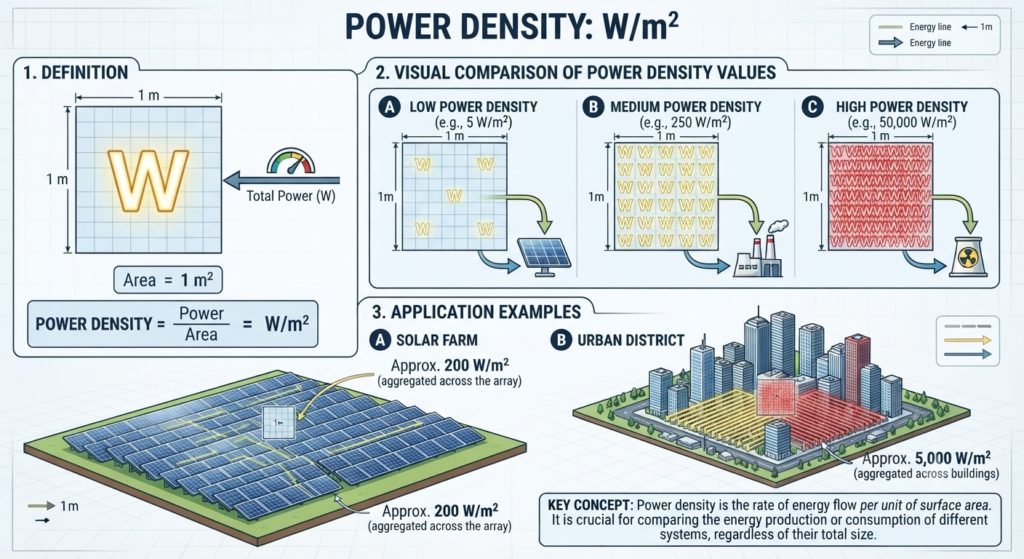
Power Density Formula
The general power density formula is:
where:
- P = power in watts (W)
- X = the relevant physical quantity
Depending on the application, X may be:
- Volume
- Mass
- Area
Volumetric Power Density
When power is divided by volume:
where:
- P = power (W)
- V = volume (m³)
The unit is:
W/m³
This form is useful when the physical size of equipment is important, such as power converters, generators, transformers, fuel cells, and electronic equipment.
Gravimetric Power Density
When power is divided by mass:
where:
- P = power (W)
- m = mass (kg)
The unit is:
W/kg
This measurement is particularly useful for batteries, electric motors, engines, fuel cells, and portable power systems.
Area Power Density
When power is divided by surface area:
where:
- P = power (W)
- A = area (m²)
The unit is:
W/m²
Other units such as W/cm² may be used when dealing with small areas, particularly in semiconductor and laser applications.
Units of Power Density
There is no single unit for power density because the appropriate unit depends on the engineering application.
| Type | Formula | Common Unit | Typical Applications |
|---|---|---|---|
| Volumetric | P/V | W/m³ | Power equipment, fuel cells |
| Gravimetric | P/m | W/kg | Batteries, motors, engines |
| Areal | P/A | W/m² | Solar, RF, thermal systems |
| Engine Power Density | P/V | kW/L | Internal combustion engines |
| Semiconductor | P/A | W/cm² | Microprocessors |
| Laser | P/A | W/cm² | Cutting, welding, materials processing |
Choosing the correct form of power density is important because two systems can have very different characteristics depending on whether they are compared by mass, volume, or area.
Power Density vs. Energy Density
These two terms power density and energy density are related but fundamentally different concepts.
Power density describes how quickly energy can be delivered or converted, while energy density describes how much energy can be stored.
Power density answers:
How much power can the system deliver relative to its size or weight?
Energy density answers:
How much energy can the system store relative to its size or weight?
For example, a battery can have high energy density but comparatively lower power density. It may store a large amount of energy but cannot necessarily release all of that energy extremely quickly.
Supercapacitors provide the opposite example. They can deliver very high power for short periods but generally store less energy than batteries of comparable mass.
This distinction is particularly important in electric vehicles and energy-storage systems.
Power Density and the Ragone Plot
Engineers often use a Ragone plot to compare energy-storage technologies.
A Ragone plot typically places:
- Energy density on one axis
- Power density on the other axis
The resulting comparison shows whether a technology is better suited for:
- Long-duration energy delivery
- High-power short-duration applications
- Rapid charging and discharging
- Hybrid energy-storage systems
Lithium-ion batteries generally provide a useful balance between energy density and power density, while supercapacitors are particularly valuable where rapid power delivery is required.
This is why hybrid systems can combine batteries and supercapacitors. The battery can provide sustained energy while the supercapacitor handles short-duration power peaks.
Power Density in Batteries
In battery systems, power density is commonly expressed in W/kg.
It indicates how much electrical power a battery can deliver relative to its mass.
For example, consider a battery that weighs 20 kg and can deliver 10 kW:
Higher battery power density can be valuable in applications requiring rapid power delivery, such as:
- Electric vehicles
- Power tools
- Hybrid vehicles
- Uninterruptible power supplies
- Grid frequency regulation
- Industrial equipment
However, maximizing power density is not the only objective. Battery designers must also consider energy density, thermal management, cycle life, safety, cost, and charging performance.
Power Density in Electric Vehicles
Power density is particularly important in electric vehicle design.
An electric vehicle needs sufficient power for:
- Acceleration
- Hill climbing
- High-speed operation
- Regenerative braking
- Short-duration power demand
A high-power-density battery and electric motor can provide strong performance without adding excessive weight.
The relationship can be summarized as:
Higher Power Density → Lower Weight for the Same Power → Better Vehicle Performance
However, higher power density can increase heat generation and thermal-management requirements. Therefore, battery and motor designers must balance power capability with temperature control and durability.
Power Density in Electric Motors
Electric motors are often evaluated using power relative to their mass or volume.
For a motor:
A motor producing 200 kW and weighing 100 kg has:
High motor power density is desirable in applications where weight and space are important, including:
- Electric vehicles
- Drones
- Aircraft
- Robotics
- Portable machinery
- Industrial automation
Motor power density can be influenced by electromagnetic loading, cooling capability, operating speed, materials, insulation systems, and mechanical design.
Power Density in Engines
Internal combustion engines are frequently compared using kW/L, where power is divided by engine displacement.
The formula is:
For example, an engine producing 150 kW from a 2.0-liter displacement has:
Turbocharging and supercharging can substantially increase engine power density because forced induction allows more air and fuel to participate in combustion within the same engine displacement.
High power density can therefore allow a smaller engine to produce the power previously associated with a larger engine.
Power Density in Power Electronics
Power converters, inverters, rectifiers, variable-frequency drives, and DC-DC converters in power electronics are increasingly designed to provide more power from smaller packages.
For a converter:
For example, if a 50 kW converter occupies 0.1 m³:
Increasing power density can reduce equipment size and installation space. However, it also creates thermal challenges because losses become concentrated in a smaller physical volume.
Power Density in Solar Energy
Solar power systems are often evaluated using power per unit area.
The basic relationship is:
It can be expressed in W/m².
For photovoltaic systems, the available solar irradiance, module efficiency, temperature, orientation, and shading influence how much electrical power can be generated from a given area.
For example, if a solar panel receives 1,000 W/m² of solar irradiance and has an efficiency of 20%, the approximate electrical output is:
This is why improving photovoltaic efficiency can increase the amount of electrical power generated from a limited roof or land area.
Power Density in Fuel Cells
Fuel-cell systems also use power density to evaluate how much power can be produced relative to system mass or volume.
For example:
Higher power density can reduce the size and weight of fuel-cell systems.
This is important in:
- Transportation
- Backup power
- Distributed generation
- Portable power
- Aerospace applications
However, the complete system should be considered rather than only the fuel-cell stack. Supporting equipment such as compressors, cooling systems, pumps, controls, and fuel-storage components can significantly affect the overall system-level power density.
Power Density in Microprocessors
Modern semiconductor devices generate substantial heat from a very small area.
For a processor:
The unit is commonly W/cm².
As more computational capability is integrated into smaller semiconductor packages, thermal management becomes increasingly important.
If a processor dissipates 150 W over an area of 3 cm²:
The heat must be transferred from the semiconductor junction to the package and eventually to the surrounding environment.
This is why modern computing systems increasingly rely on advanced cooling technologies.
Power Density in Lasers
Laser applications demonstrate why power concentration matters.
Suppose a laser produces 100 W of optical power and focuses the beam onto an area of 0.01 cm².
Then:
The total laser power has not changed. What has changed is the area over which that power is concentrated.
As the beam becomes more tightly focused, the power density increases.
This principle enables laser systems to perform operations such as:
- Cutting
- Welding
- Drilling
- Engraving
- Surface treatment
- Material processing
Power Density in Radio Frequency Systems
In radio-frequency applications, power density describes the electromagnetic power incident on a particular surface area.
It is commonly expressed in:
- W/m²
- mW/cm²
Power density can be relevant when evaluating electromagnetic fields around:
- Radio transmitters
- Antennas
- Cellular infrastructure
- Radar systems
- Wireless communication equipment
In these applications, power density helps characterize the intensity of electromagnetic energy at a particular location.
Exposure assessment, however, depends on frequency, distance, antenna characteristics, exposure duration, applicable regulations, and other factors. Therefore, power density should not be interpreted as a universal safety limit without reference to the applicable standard.
Power Density in Data Centers
Data centers are increasingly concerned with power density because computing equipment is becoming more powerful while rack space remains limited.
Data-center power density is often discussed in terms of kW per rack.
For example, a rack consuming 30 kW has a substantially greater power requirement than a conventional rack consuming 5 kW.
Higher rack power density affects:
- Electrical distribution
- UPS sizing
- Cable systems
- Cooling capacity
- Airflow management
- Floor loading
- Backup generation
- Facility design
The growth of AI and high-performance computing has made power density an increasingly important consideration in data-center design.
Power Density in Electrical Engineering
For electrical engineers, power density is particularly important when designing compact and high-performance equipment.
It can influence the design of:
- Transformers
- Motors
- Generators
- Inverters
- Rectifiers
- UPS systems
- Variable-frequency drives
- Switch-mode power supplies
- Batteries
- Power semiconductor modules
- Data centers
For example, a transformer designer must consider not only its rated kVA but also its physical size, losses, temperature rise, insulation system, cooling method, and material utilization.
Similarly, a VFD designer must fit switching devices, capacitors, inductors, heat sinks, control electronics, and protection systems into a compact enclosure while maintaining acceptable thermal performance.
Power Density and Heat Dissipation
One of the most important consequences of increasing power density is heat generation.
Electrical equipment is never perfectly efficient. Some input power is converted into heat through:
- Conduction losses
- Switching losses
- Magnetic losses
- Mechanical losses
- Semiconductor losses
- Resistance
As power becomes concentrated into a smaller area or volume, the thermal load becomes more difficult to remove.
The relationship can be represented as:
Higher Power Density → Higher Local Heat Flux → Greater Cooling Requirement
This is particularly important in:
- CPUs
- GPUs
- Power semiconductors
- Electric motors
- Batteries
- Inverters
- Data centers
- Transformers
Cooling technologies may include natural convection, forced-air cooling, heat sinks, heat pipes, liquid cooling, vapor chambers, and immersion cooling.
Why Does Power Density Matter?
The importance of power density comes down to one fundamental engineering objective:
Deliver or process more power using less mass, volume, or area.
Higher power density provides several important advantages:
- Smaller Equipment: A high-power-density system can provide the required power output using less physical space.
- Lower Weight: In transportation, aerospace, electric vehicles, and portable equipment, reducing system weight can improve efficiency and performance.
- Better Space Utilization: Higher power density allows more electrical, mechanical, or computing capability to be installed within a limited area.
- Higher Performance: Motors, batteries, engines, generators, and power converters can deliver more power without a proportional increase in their physical size.
- Reduced Infrastructure Requirements: Compact equipment can reduce the space required for installation, cooling, cabling, structural support, and other auxiliary systems.
- Improved System Integration: Higher power density makes it easier to integrate multiple functions and components into compact systems.
- Greater Design Flexibility: Engineers can achieve the required power output while having more flexibility in equipment size, weight, and installation arrangements.
However, higher power density also creates challenges, particularly related to heat generation, cooling, component stress, reliability, safety, and cost.
Challenges of High Power Density
Increasing power density is not always beneficial without considering the associated engineering limitations. As more power is concentrated into a smaller mass, volume, or area, several challenges can arise:
- Thermal Management: More power concentrated in a smaller space generally produces higher heat flux, making heat removal and cooling more difficult.
- Material Stress: Higher power levels can increase electrical, mechanical, and thermal stresses on components and materials.
- Reliability: Higher operating temperatures and increased stresses can accelerate component aging, reduce service life, and increase the risk of failure.
- Safety: High power density can increase electrical, thermal, mechanical, and electromagnetic hazards if appropriate protection and design measures are not provided.
- Cooling Requirements: High-power-density equipment may require advanced cooling methods such as forced-air, liquid cooling, heat pipes, or other thermal-management technologies.
- Higher Cost: Achieving very high power density may require advanced materials, high-performance components, sophisticated cooling systems, and more complex designs.
- Maintenance Complexity: Compact, high-power systems can be more difficult to inspect, repair, and maintain because components are closely integrated.
Power Density vs. Efficiency
Power density and efficiency should not be confused.
A system may have high power density but relatively poor efficiency. Conversely, a highly efficient system may not have exceptionally high power density.
Efficiency describes how much input power is converted into useful output:
Power density describes how much power is associated with a unit of mass, volume, or area.
An effective engineering design therefore aims for both:
High Power Density + High Efficiency + Acceptable Temperature + High Reliability
How to Increase Power Density
Engineers can increase power density by improving materials, reducing losses, optimizing component design, and improving thermal management. Common approaches include:
- Improve Materials: Advanced magnetic, semiconductor, conductor, and structural materials can allow equipment to operate at higher power levels while maintaining acceptable temperature, electrical, and mechanical stresses.
- Increase Operating Frequency: In power electronics and magnetic components, higher switching frequencies can reduce the required size of transformers, inductors, and other magnetic components, helping achieve more compact designs.
- Improve Cooling: Better thermal management allows components to handle higher power without exceeding their permissible temperature limits. Air cooling, liquid cooling, heat sinks, heat pipes, and other cooling techniques can be used depending on the application.
- Reduce Losses: Lower conduction losses, switching losses, magnetic losses, and mechanical losses reduce heat generation and allow more useful power to be processed within the same physical space.
- Optimize Packaging: Compact mechanical and electrical layouts can reduce unused space and allow components to be positioned more efficiently within the available volume.
- Increase Component Performance: High-performance semiconductor technologies such as silicon carbide (SiC) and gallium nitride (GaN) can support higher switching frequencies, lower losses, and more compact power-electronic systems in suitable applications.
- Optimize System Design: Combining electrical, mechanical, and thermal design from the beginning can help achieve higher power density without compromising efficiency, reliability, or safety.
Advanced Materials + Higher Frequency + Lower Losses + Better Cooling + Compact Design → Higher Power Density
Power Density Example
Consider two power converters.
Converter A
- Power rating = 100 kW
- Volume = 0.5 m³
Converter B
- Power rating = 100 kW
- Volume = 0.25 m³
From above, it is clear that Converter B has twice the volumetric power density of Converter A.
However, this does not automatically mean Converter B is the better design. Engineers must also compare:
- Efficiency
- Temperature rise
- Cooling requirements
- Reliability
- Cost
- Maintenance
- Service life
This illustrates why power density is a useful performance metric but should not be considered in isolation.
Key Difference Between Power Density and Energy Density
| Parameter | Power Density | Energy Density |
|---|---|---|
| Measures | Rate of energy transfer | Amount of stored energy |
| Main Question | How fast can energy be delivered? | How much energy can be stored? |
| Common Units | W/kg, W/m³, W/m² | Wh/kg, Wh/m³ |
| Important For | Acceleration, peak loads, rapid discharge | Operating time, range, storage capacity |
| Example | Supercapacitor | Battery |
The distinction is especially important when evaluating energy-storage technologies.
Conclusion
Power density is a measure of how much power can be delivered, generated, processed, or dissipated relative to mass, volume, or area. Its fundamental relationship is simple:
Depending on the application, it may be expressed in W/kg, W/m³, W/m², W/cm², or kW/L.
Power density is important because modern engineering increasingly demands more power from smaller, lighter, and more compact systems. It influences the design and performance of batteries, electric motors, engines, solar systems, fuel cells, power electronics, semiconductors, lasers, RF systems, and data centers.
However, increasing power density also increases thermal and reliability challenges. The best engineering solution is therefore not simply the system with the highest power density, but the one that achieves an appropriate balance between power, size, efficiency, cooling, reliability, safety, and cost.
In simple terms:
More Power + Less Mass/Volume/Area → Higher Power Density
That simple relationship explains why power density remains an important metric across modern electrical, mechanical, energy, and electronic engineering.
Read Next:
- Energy Intensity: Definition, Formula, Examples
- Energy Diversification: Meaning, Importance, Types, Benefits
- Energy Density: Definition, Formula, Types, Units
- Energy Efficiency vs. Energy Intensity
- Net Zero: Meaning, How It Works
- Coefficient of Performance (COP): Formula, Types & Examples
- Energy Efficiency Ratio (EER): Definition, Formula, Examples