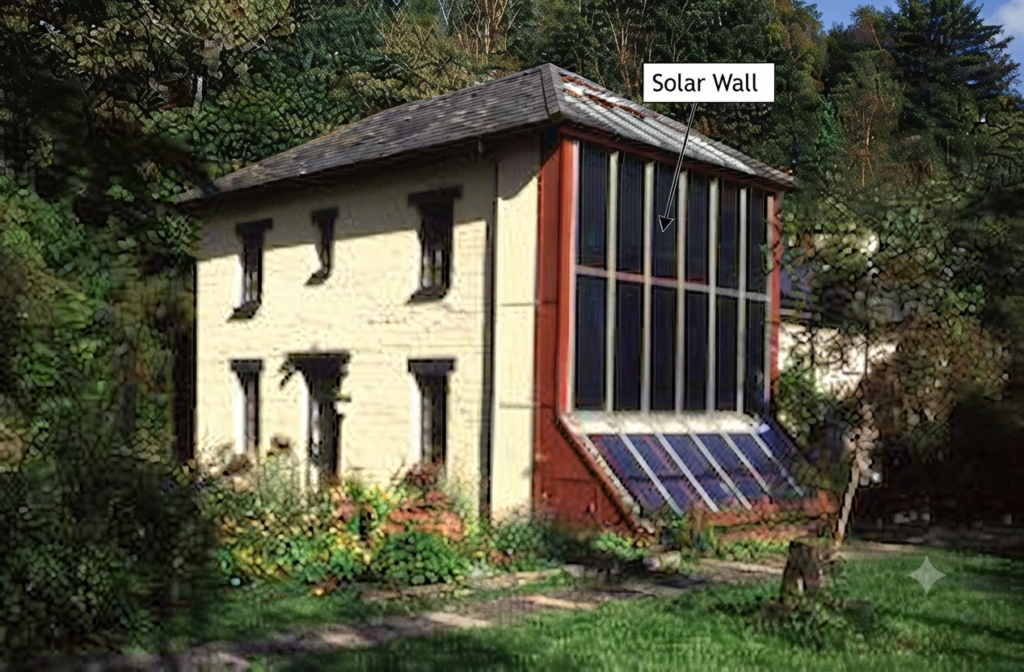
A solar wall is a building-integrated solar heating system that captures sunlight and uses it to provide useful heat for indoor spaces. It is primarily designed to reduce the energy required for conventional space heating and ventilation. Solar walls are related to other passive solar technologies, such as Trombe walls and solar chimneys, and can form part of an energy-efficient building design.
The system can be incorporated into a newly constructed building or added to an existing structure as a retrofit. By making use of solar energy that falls on the building façade, a solar wall can provide supplemental heating without directly relying on fuel combustion.
Solar Wall Construction
A typical solar wall consists of a perforated metal panel or cladding installed in front of an existing exterior wall. The two surfaces are separated by a narrow cavity that acts as an air passage.
For buildings in the Northern Hemisphere, the collector is generally positioned on a south-facing wall so that it can receive greater amounts of sunlight during the heating season. The metal cladding is normally dark in color because a darker surface absorbs more solar radiation and reflects less of the incident sunlight.
The space between the collector and the building wall forms an air channel. Openings, ducts, and ventilation equipment are incorporated into the system to move heated air into the building.

How a Solar Wall Works
The operation of a solar wall begins when sunlight strikes the perforated metal collector. The dark-colored surface absorbs solar radiation and becomes heated. Air passing through the perforations and the cavity behind the collector gains heat from the warmed metal surface.
A ventilation system is generally connected to the solar wall to control the movement of air. Fans create a pressure difference within the air cavity, which helps draw air through the collector and into the heated space.
During operation, relatively cool air from the building is directed toward the lower portion of the solar wall. As the air passes through or along the heated collector, its temperature increases. The warmed air then moves upward through the cavity and is collected near the upper section of the wall.
The heated air is subsequently connected to the building’s HVAC system, which distributes it throughout the occupied space. This arrangement allows solar energy captured at the exterior façade to contribute directly to indoor heating and ventilation.
Role of the Perforated Collector
The perforated metal collector is one of the most important components of a solar wall. Its dark surface is designed to absorb a substantial portion of the incoming solar radiation, while the perforations allow air to pass through the collector.
The collector’s performance depends on factors such as solar intensity, surface properties, airflow rate, ambient temperature, wall orientation, and the design of the air cavity. Proper positioning and ventilation are therefore important for obtaining useful heat from the system.
Solar Wall in Energy-Efficient Buildings
Solar walls demonstrate how a building façade can be used not only as an enclosure but also as a means of collecting renewable thermal energy. By integrating solar heat collection with the building’s ventilation system, the technology can reduce the workload of conventional heating equipment.
The greatest benefit is generally obtained when the wall has good solar exposure and the building has a significant heating requirement. Because the system can be added to existing structures, it can also be considered as an option for improving the energy performance of suitable older buildings.
Advantages of Solar Walls
Solar walls can provide several energy and environmental benefits:
- Reduced heating demand: Solar energy supplies part of the heat needed for indoor spaces, reducing dependence on conventional heating equipment.
- Lower fuel consumption: Because the system utilizes sunlight as a heat source, less fuel may be required for heating.
- Reduced carbon emissions: Lower consumption of fuel for space heating can help decrease associated carbon dioxide emissions.
- Improved building performance: The additional collector layer can provide a degree of thermal protection to the original exterior wall.
- Retrofit potential: Solar walls can be installed on existing buildings as well as incorporated into new construction.
- Relatively simple design: The basic arrangement consists of a perforated collector, an air cavity, supporting components, and suitable ventilation connections.
The collector also acts as an additional layer over the building façade. During cold weather, this layer can reduce the direct exposure of the original wall to cold outdoor air, providing an additional thermal benefit.
Conclusion
A solar wall is a practical solar heating technology that uses a perforated exterior collector to capture solar radiation and heat air before it enters a building. The heated air can be supplied through the HVAC system to provide useful space heating and ventilation. With relatively simple construction, retrofit capability, reduced fuel requirements, and potential reductions in heating-related emissions, solar walls can contribute to more energy-efficient and sustainable buildings.
Read Next: