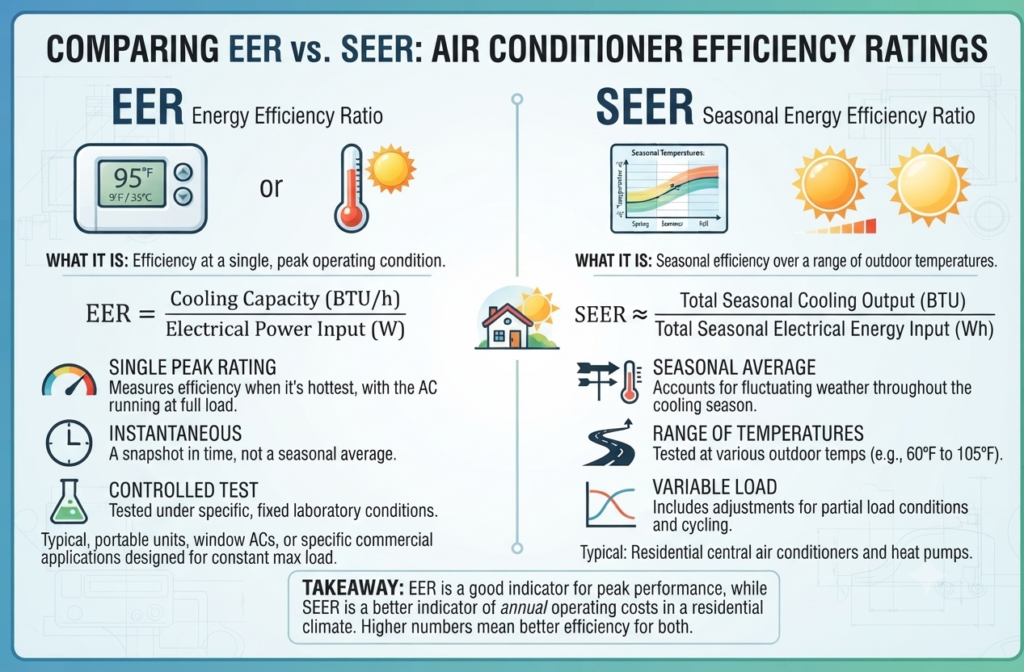
The main difference between EER vs. SEER is that EER (Energy Efficiency Ratio) measures an air conditioner’s cooling efficiency under a specific, standardized operating condition, while SEER (Seasonal Energy Efficiency Ratio) measures average cooling efficiency over an entire cooling season. EER is therefore primarily a full-load or peak-condition performance indicator, whereas SEER is a seasonal efficiency indicator used to evaluate overall cooling performance.
Understanding EER vs. SEER is important because the two ratings describe different aspects of the same air-conditioning system. A unit may have a relatively high SEER but a lower EER because much of its seasonal operation occurs under milder conditions and at partial capacity. Conversely, a system with a higher EER may perform better when operating near full load during very hot weather.
For most homeowners, SEER2 is useful when comparing seasonal energy performance and potential annual cooling costs, while EER2 is particularly useful for evaluating performance during hot, high-load conditions. The updated EER2 and SEER2 ratings have been used for applicable equipment since January 2023.
EER vs. SEER Comparison Table
The table below highlights the major differences between EER vs. SEER.
| Feature | EER | SEER |
|---|---|---|
| Full Name | Energy Efficiency Ratio | Seasonal Energy Efficiency Ratio |
| Definition | Cooling efficiency under a specified test condition | Average cooling efficiency over a standardized cooling season |
| Main Focus | Full-load or high-temperature performance | Seasonal and part-load performance |
| Outdoor Temperature | Standardized condition of 95°F | Multiple outdoor temperatures during the cooling season |
| Indoor Condition | 80°F and 50% relative humidity | Based on standardized seasonal test conditions |
| Operating Pattern | Steady-state/full-load | Combination of part-load and full-load operation |
| Basic Measurement | Cooling output ÷ electrical input | Total seasonal cooling output ÷ total seasonal electrical consumption |
| Common Use | Peak-condition comparison | Annual/seasonal efficiency comparison |
| Direction of Improvement | Higher EER is generally better | Higher SEER is generally better |
| Updated Version | EER2 | SEER2 |
| Best For | Hot-weather and high-load performance | Seasonal energy-use comparison |
What Is EER?
Energy Efficiency Ratio (EER) is a measure of how efficiently an air conditioner produces cooling under a specified set of operating conditions.
In simple terms:
For example, if an air conditioner provides 12,000 Btu/h of cooling while consuming 1,000 watts, its EER is:
Therefore:
EER = 12 Btu/Wh
The standardized EER test uses a fixed outdoor temperature of approximately 95°F, along with specified indoor conditions. Because the test represents a high cooling-load condition, EER provides useful information about how an AC performs when outdoor temperatures are high and the compressor is working hard.
Examples of EER Applications
EER is particularly useful when:
- Comparing full-load cooling performance
- Evaluating equipment for hot climates
- Assessing window and room air conditioners
- Comparing peak-condition efficiency
- Evaluating electricity consumption during high cooling demand
A higher EER generally means that the air conditioner can produce the same amount of cooling with less electrical input under the specified test condition.
What Is SEER?
Seasonal Energy Efficiency Ratio (SEER) measures the average cooling efficiency of an air conditioner over a standardized cooling season.
Unlike EER, SEER does not represent just one operating condition. It considers cooling operation across a range of outdoor temperatures and operating conditions.
A simplified representation is:
SEER therefore provides a broader indication of how efficiently an air conditioner operates over time.
The rating includes periods when the system operates at lower cooling loads. This is particularly relevant for two-stage and variable-speed systems, which can adjust their capacity instead of always operating at maximum output.
EER vs. SEER: Key Differences
1. Meaning
The primary difference between EER vs. SEER is the operating period represented by each rating.
EER focuses on performance under a specific standardized condition.
SEER represents average performance across a standardized cooling season.
2. Main Focus
EER is mainly concerned with high-load or steady-state performance.
Typical questions include:
- How efficiently does the AC operate at 95°F outdoor temperature?
- How much electricity does the unit require at high cooling load?
- How does the system perform during very hot weather?
SEER takes a broader seasonal perspective:
- How efficiently does the AC operate throughout the cooling season?
- How well does it perform during part-load conditions?
- What does its overall seasonal efficiency look like?
3. Measurement Conditions
EER is determined at a specific standardized test condition.
The commonly referenced condition includes:
- Outdoor temperature: 95°F
- Indoor temperature: 80°F
- Indoor relative humidity: 50%
SEER is determined using a range of operating conditions intended to represent seasonal cooling operation.
4. Part-Load Operation
One of the most important differences between EER and SEER is how they reflect part-load operation.
An air conditioner does not normally operate at maximum capacity throughout the entire cooling season.
When outdoor temperatures are moderate, the cooling load is lower. A single-stage compressor may cycle on and off, while a two-stage or variable-speed compressor can reduce its output.
This can significantly affect seasonal efficiency.
As a result:
Part-Load Operation → Lower Cooling Load → Reduced Capacity → Potentially Higher Seasonal Efficiency
SEER captures this broader operating behavior, while EER is primarily a full-load measurement.
5. Why SEER Is Usually Higher Than EER
The same air conditioner may have ratings such as:
12 EER / 18 SEER
This does not mean that one rating is incorrect.
The two numbers are calculated under different testing approaches.
EER evaluates performance under a demanding standardized condition. SEER incorporates operation under a broader range of temperatures, including milder conditions where the system may operate more efficiently.
Consequently, the seasonal average can be significantly higher than the EER value.
6. Equipment Type and Efficiency
The difference between SEER and EER can also vary depending on compressor technology.
For example:
| System Type | Example EER | Example SEER | Approximate SEER/EER Ratio | Part-Load Performance |
|---|---|---|---|---|
| Single-stage | 11 | 14 | 1.27 | Limited |
| Two-stage | 11.5 | 17 | 1.48 | Moderate |
| Variable-speed | 12 | 22 | 1.83 | Strong |
These are illustrative examples rather than universal rating conversions.
Variable-speed systems can show a larger difference between SEER and EER because they are capable of continuously adjusting cooling capacity to match the building load.
Therefore:
Larger SEER/EER Gap → Greater Seasonal Part-Load Advantage
However, a large SEER/EER difference does not necessarily mean the system will have the lowest energy consumption during the hottest hours of the day.
Relationship Between EER and SEER
EER and SEER are closely related because both evaluate the relationship between cooling output and electrical energy consumption.
However, they answer different questions.
A useful way to visualize the relationship is:
Outdoor Temperature → Cooling Load → Compressor Operation → Electrical Consumption → Seasonal Efficiency
As outdoor conditions change, the cooling load changes. The air conditioner may therefore operate at different capacities throughout the season.
Approximate EER-to-SEER Relationship
There is no exact formula for converting EER into SEER.
The relationship depends on:
- Compressor design
- Compressor staging
- Variable-speed operation
- Fan power
- Controls
- Cycling characteristics
- Equipment capacity
- Part-load efficiency
- Test procedures
As a rough comparison, the following relationships may be observed:
| System Type | Approximate SEER/EER Relationship |
|---|---|
| Single-stage | 1.2–1.3 × EER |
| Two-stage | 1.4–1.5 × EER |
| Variable-speed | 1.6–1.9 × EER |
These ratios should be used only as general guidelines.
They should not be treated as an official conversion equation for determining the actual SEER rating of an air conditioner.
The same principle applies when comparing EER2 and SEER2.
Which Rating Should You Prioritize?
The appropriate rating depends on the climate, equipment, electricity pricing, and operating pattern.
Prioritize SEER or SEER2 When:
SEER2 is particularly useful when you are interested in seasonal performance.
It can be prioritized when:
- You live in a moderate or mixed climate.
- Cooling occurs across a wide range of outdoor temperatures.
- You want to estimate seasonal energy consumption.
- You are comparing central air-conditioning systems.
- The system spends significant time operating below maximum capacity.
- Your main concern is annual cooling cost.
In these situations:
SEER2 → Seasonal Efficiency → Annual Energy Comparison
Prioritize EER or EER2 When:
EER2 becomes especially useful when the AC frequently operates under high-load conditions.
Consider EER2 more carefully when:
- You live in an extremely hot climate.
- The AC operates for long periods near full capacity.
- Summer temperatures are very high.
- Peak cooling demand is an important concern.
- You are evaluating a room, window, or similar air-conditioning unit.
- You want to compare performance during very hot conditions.
In these situations:
EER2 → High-Load Efficiency → Peak-Condition Comparison
EER vs. SEER in Hot Climates
Climate can significantly influence which rating deserves greater attention.
In very hot regions, air conditioners may spend substantial amounts of time operating at high capacity. Under these conditions, EER2 can provide valuable information about electricity consumption during demanding periods.
For example:
Very Hot Weather → Higher Cooling Load → Higher Compressor Loading → Greater Electrical Demand
Therefore, a system with a strong EER2 may perform particularly well during peak summer conditions.
However, even in hot climates, the air conditioner does not operate at maximum load every hour of the season. SEER2 therefore remains relevant when evaluating total seasonal performance.
EER vs. SEER in Moderate Climates
In moderate climates, the AC may spend more operating hours under relatively mild outdoor conditions.
During these periods, a system with effective part-load control can operate efficiently at reduced capacity.
This makes SEER2 particularly useful for comparing seasonal performance.
The simplified relationship is:
Moderate Weather → Lower Cooling Load → More Part-Load Operation → Greater Importance of Seasonal Efficiency
EER vs. SEER for Variable-Speed Air Conditioners
Variable-speed systems can modulate compressor capacity according to the cooling requirement.
Instead of repeatedly switching between full output and off, the compressor can operate at lower speeds for extended periods.
This can provide advantages such as:
- Better part-load efficiency
- Longer operating cycles
- More stable indoor temperature
- Potentially improved humidity control
- Reduced cycling losses
Because SEER captures seasonal operation, variable-speed systems can have a particularly high SEER compared with their EER.
However:
High SEER → Strong Seasonal Performance
does not necessarily mean:
High SEER → Highest Full-Load Efficiency
EER2 should still be examined when peak-condition performance matters.
EER vs. SEER for Window and Room Air Conditioners
EER can be especially useful when comparing smaller air-conditioning systems that frequently operate at or near their rated capacity.
For these systems, the user may want to know:
- How much cooling is produced?
- How much electricity is consumed?
- How efficient is the unit at the specified test condition?
In such cases, EER provides a straightforward efficiency comparison.
Where both EER2 and SEER2 information are available, examining both ratings provides a more complete picture.
EER vs. SEER: Real-World Example
Consider two 3-ton air-conditioning systems operating in a hot climate.
System A
- 22 SEER2
- 11.5 EER2
- Variable-speed compressor
System B
- 17 SEER2
- 13.0 EER2
- Two-stage compressor
The higher SEER2 rating of system A, suggesting stronger seasonal efficiency. Its variable-speed compressor can reduce capacity during lower cooling loads.
System B has the higher EER2, indicating better efficiency under the specified high-load test condition.
Therefore:
System A → Better seasonal efficiency
System B → Better standardized full-load efficiency
If the objective is annual energy comparison, System A may have an advantage.
If the objective is performance during very hot, high-load conditions, System B’s higher EER2 may become more significant.
Actual electricity costs will depend on factors such as:
- Local climate
- Cooling hours
- Equipment sizing
- Thermostat settings
- Building insulation
- Duct losses
- Maintenance
- Electricity rates
- Operating schedule
Therefore, rating numbers should be used as part of a broader equipment evaluation.
How EER and SEER Affect AC Energy Consumption
The relationship between efficiency and energy consumption can be expressed conceptually as:
Higher Efficiency → Lower Energy Required for the Same Cooling Output
For EER:
Higher EER → Lower Electrical Input at the Tested Condition
For SEER:
Higher SEER → Lower Seasonal Electrical Consumption for a Given Seasonal Cooling Output
This does not mean that a high-rated system will always use less electricity in every building. Actual energy consumption depends heavily on the cooling load and operating conditions.
EER2 vs. SEER2
The original EER and SEER ratings have newer counterparts known as EER2 and SEER2.
The updated ratings were introduced for applicable residential air-conditioning equipment in January 2023 as part of changes to the testing procedures.
Therefore:
EER → EER2
SEER → SEER2
When comparing modern equipment, it is preferable to compare ratings that are based on the same testing methodology.
Older EER/SEER values and newer EER2/SEER2 values should not automatically be assumed to be directly interchangeable.
Common Mistakes When Comparing EER and SEER
Mistake 1: Assuming EER and SEER Are the Same Rating
They are not.
EER represents performance under a specific condition, while SEER represents seasonal performance.
Mistake 2: Assuming the Highest SEER Has the Best Peak Performance
A high SEER does not necessarily mean the equipment has the highest EER.
Always check EER2 when high-temperature performance is important.
Mistake 3: Using EER to Estimate Annual Energy Consumption
EER is not designed to represent the complete seasonal operating profile.
SEER2 is generally more appropriate for seasonal comparisons.
Mistake 4: Ignoring Climate
The value of seasonal and peak-condition ratings depends strongly on local weather conditions.
Mistake 5: Treating the EER-to-SEER Ratio as a Conversion Formula
The relationship varies by equipment design and operating characteristics.
Mistake 6: Comparing Old and New Ratings Without Considering the Test Method
EER and EER2, as well as SEER and SEER2, are associated with different testing procedures.
How to Choose an Efficient Air Conditioner
A practical AC selection process can include the following steps.
Step 1: Determine the Cooling Requirement
Choose equipment with an appropriate capacity for the building rather than selecting a unit based only on efficiency rating.
Step 2: Consider the Local Climate
Determine whether the system will mainly operate under moderate conditions or extreme summer temperatures.
Step 3: Compare SEER2
Use SEER2 to compare seasonal efficiency and potential annual energy performance.
Step 4: Check EER2
Examine EER2 to understand high-load performance, particularly in hot climates.
Step 5: Evaluate Compressor Technology
Consider whether single-stage, two-stage, or variable-speed operation is appropriate for the application.
Step 6: Consider Operating Cost
Compare the expected energy savings with the purchase and installation cost.
Step 7: Consider the Complete System
Installation quality, ductwork, insulation, airflow, maintenance, and correct sizing can significantly influence actual AC performance.
EER vs. SEER: Which Is More Important?
Neither rating is universally more important.
EER is particularly useful for evaluating high-load and peak-condition efficiency.
SEER is more useful for evaluating seasonal efficiency and overall cooling performance.
For most central AC comparisons:
SEER2 → Primary seasonal efficiency indicator
EER2 → Secondary high-load performance indicator
For extremely hot climates, EER2 deserves additional attention.
The best approach is therefore:
SEER2 + EER2 → More Complete AC Efficiency Evaluation
EER vs. SEER and Electricity Cost
Efficiency ratings can help compare potential electricity consumption, but the rating alone does not determine the final electricity bill.
A simplified relationship is:
Cooling Load + Operating Hours + Equipment Efficiency + Electricity Rate → Cooling Cost
For example, two homes using identical air conditioners may have very different electricity consumption because of differences in:
- Building size
- Insulation
- Windows
- Outdoor temperature
- Indoor temperature setting
- Occupancy
- Solar heat gain
- Ductwork
- Operating hours
Therefore, EER and SEER should be viewed as equipment performance indicators, not guarantees of actual utility costs.
Conclusion
The comparison of EER vs. SEER shows that both ratings are important but measure different aspects of air-conditioner performance. EER measures cooling efficiency under a specified standardized condition, while SEER evaluates average efficiency across a cooling season.
EER is particularly useful for understanding high-temperature and full-load performance, whereas SEER is better suited to seasonal efficiency and annual energy comparisons.
A high SEER does not necessarily mean that a system will have the highest EER. This is especially important when comparing variable-speed equipment with single-stage or two-stage systems.
For modern equipment, the updated ratings EER2 and SEER2 should be used when available.
A practical approach is:
SEER2 → Evaluate Seasonal Efficiency → Compare Annual Performance
EER2 → Evaluate High-Load Efficiency → Check Hot-Weather Performance
Ultimately, selecting an efficient air conditioner requires looking beyond a single rating. Climate, equipment capacity, compressor technology, operating hours, installation quality, and electricity prices all influence real-world energy consumption.
Frequently Asked Questions (FAQs)
EER measures air-conditioner efficiency at a specific standardized operating condition, while SEER measures average efficiency over a standardized cooling season.
For the same equipment, SEER is generally higher than EER because the seasonal rating accounts for operation under a broader range of conditions, including periods when the system operates at reduced capacity.
A higher SEER generally indicates better seasonal efficiency, but it does not necessarily mean better performance during peak-temperature conditions. EER2 should also be considered when full-load efficiency matters.
In very hot climates, EER2 becomes particularly important because the AC may operate near full capacity for extended periods. However, SEER2 should also be considered for total seasonal performance.
No exact conversion exists. The relationship between EER and SEER depends on compressor technology, controls, cycling, fan operation, and part-load performance.
Read Next:
- Energy Efficiency Ratio (EER): Definition, Formula, Examples, and Applications
- EER Chart for Air Conditioners: Good, Average and Excellent Ratings
- What Does Ton Mean in Air Conditioning?
- Coefficient of Performance (COP): Formula, Types & Examples
- Power Density: Definition, Formula, Units, Applications
- SEER Rating Explained: Complete Guide to AC Efficiency