Energy diversification is the strategy of using a balanced mix of different energy sources, technologies, suppliers, and energy carriers instead of relying heavily on a single source. It can include a combination of renewable energy, fossil fuels, nuclear energy, electricity, natural gas, bioenergy, hydrogen, energy storage, and other energy resources, depending on the needs and circumstances of a country, organization, or industry.
The main purpose of energy diversification is to improve energy security, supply reliability, economic resilience, affordability, and sustainability. A diversified energy system is generally better prepared to handle fuel-price volatility, supply disruptions, geopolitical risks, resource shortages, extreme weather, and changes in energy demand.
Energy diversification is not simply about adding more energy sources. It also involves diversifying energy suppliers, geographic sources, technologies, infrastructure, and consumption patterns. At the same time, improving energy efficiency can reduce overall energy demand and further strengthen energy security.
What Is Energy Diversification?
Energy diversification means reducing dependence on a single energy source, supplier, technology, fuel, or geographic region by developing and using multiple energy options.
For example, instead of depending almost entirely on coal for electricity generation, a country could develop a portfolio that includes:
Coal → Natural Gas → Solar → Wind → Hydropower → Nuclear → Biomass → Energy Storage
The exact energy mix will vary according to resource availability, technology, economics, environmental objectives, and national energy policy.
Energy diversification can occur at several levels.
1. Source Diversification
This involves using different primary energy sources.
Examples include:
- Solar energy
- Wind energy
- Hydropower
- Coal
- Natural gas
- Nuclear energy
- Biomass
- Geothermal energy
- Petroleum
2. Supplier Diversification
A country can reduce supply risk by purchasing fuels from multiple suppliers rather than depending on one supplier or region.
3. Technology Diversification
Energy security can also be improved by using different technologies for producing, storing, and delivering energy.
Examples include:
- Solar PV
- Wind turbines
- Hydropower plants
- Thermal power plants
- Nuclear power plants
- Battery energy storage
- Pumped-storage hydropower
- Hydrogen systems
4. Geographic Diversification
Energy resources can be developed across different geographic locations.
For example, solar projects may be distributed across several regions rather than concentrated in one area.
5. Energy Carrier Diversification
Energy can be delivered through different carriers such as:
- Electricity
- Natural gas
- Hydrogen
- Liquid fuels
- Biofuels
- District heating
This can provide greater flexibility when one energy carrier becomes expensive or unavailable.
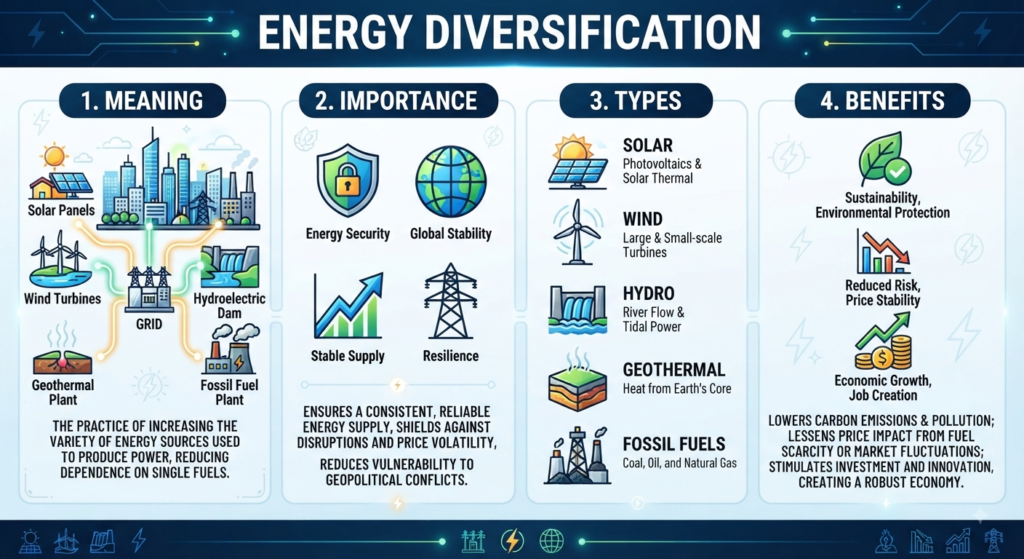
Why Is Energy Diversification Important?
Energy systems are exposed to many risks. A heavy dependence on one fuel or supplier can make an economy vulnerable to unexpected disruptions.
For example:
Single Energy Source → Supply Disruption → Energy Shortage → Higher Prices → Economic Impact
Energy diversification creates an alternative pathway:
Multiple Energy Sources → Greater Flexibility → Lower Supply Risk → Improved Energy Security
Several factors make energy diversification important.
Energy Supply Security
Diversification reduces dependence on a single source of energy. If one source becomes unavailable, other sources can help maintain supply.
Price Stability
Different fuels and technologies respond differently to market conditions. A diversified energy portfolio can reduce exposure to sudden price increases in a particular fuel.
Geopolitical Resilience
Countries that depend heavily on imported fuels can be affected by international conflicts, trade restrictions, sanctions, or political instability.
Diversifying suppliers and increasing domestic energy production can reduce these vulnerabilities.
Resource Availability
Some energy resources are finite. Diversification allows countries and industries to gradually reduce excessive dependence on resources that may become more expensive or difficult to obtain.
Environmental Sustainability
Adding renewable energy can reduce dependence on high-emission fossil fuels and support long-term decarbonization.
Types of Energy Diversification
Energy diversification can be classified in several ways.
Renewable and Non-Renewable Energy Diversification
A diversified energy system may contain both renewable and non-renewable resources.
Renewable Energy:
- Solar
- Wind
- Hydropower
- Biomass
- Geothermal
Non-Renewable Energy:
- Coal
- Oil
- Natural gas
- Nuclear fuels
The long-term direction of diversification may increasingly emphasize low-carbon and renewable sources, but the transition depends on the specific energy requirements and infrastructure of each system.
Electricity Generation Diversification
Electricity systems can diversify their generation portfolio by combining different technologies.
For example:
Solar + Wind + Hydro + Nuclear + Thermal Power + Battery Storage
This can improve system flexibility because different technologies have different operating characteristics.
Solar generation is generally strongest during daylight hours, while wind generation varies with weather conditions. Hydropower and thermal generation can provide additional flexibility where available.
Energy Diversification and Energy Security
Energy security involves ensuring that consumers have reliable access to sufficient energy at reasonable and manageable costs.
A simple relationship between energy diversification and energy security can be represented as:
Energy Diversification → Multiple Supply Options → Reduced Dependence → Greater Energy Security
Consider a country that obtains most of its natural gas from one external supplier. A disruption could create a serious shortage.
If the country instead has:
- Multiple gas suppliers
- Domestic renewable energy
- LNG infrastructure
- Hydropower
- Nuclear generation
- Energy storage
- Demand-side management
it has more options for responding to a disruption.
Therefore, diversification provides resilience and flexibility, rather than simply increasing the total quantity of energy available.
Role of Renewable Energy in Energy Diversification
Renewable energy has become an important component of modern energy diversification strategies.
Solar and wind resources are widely distributed geographically, although their availability varies by location.
Renewable energy can help reduce dependence on imported fossil fuels while also supporting emissions reduction.
A typical diversification pathway is:
Fossil-Fuel Dependence → Renewable Energy Expansion → Diverse Energy Mix → Reduced Fuel Risk → Improved Energy Security
However, renewable energy integration also requires supporting infrastructure.
Important requirements can include:
- Transmission networks
- Distribution infrastructure
- Energy storage
- Flexible generation
- Demand response
- Grid management
- Forecasting systems
- Digital monitoring
Therefore, simply installing renewable generation is not sufficient. The entire energy system must be capable of integrating it reliably.
Role of Energy Efficiency in Energy Diversification
Energy efficiency is another important part of energy diversification because reducing energy demand reduces dependence on energy supplies.
Consider the following pathway:
Energy Efficiency → Lower Energy Demand → Lower Fuel Requirement → Lower Import Dependence → Greater Energy Security
For example, if an industrial plant reduces its electricity consumption from 10,000 MWh/year to 8,000 MWh/year, it requires 2,000 MWh less energy.
This reduction can lower the amount of fuel or electricity that must be supplied.
Energy efficiency measures can include:
- High-efficiency motors
- Variable frequency drives
- Efficient pumps
- Efficient fans
- Waste heat recovery
- Improved insulation
- Efficient lighting
- Process optimization
- Energy management systems
- Preventive maintenance
Thus:
Energy Diversification + Energy Efficiency → Stronger Energy Resilience
Energy Diversification in Industry
Industrial facilities often consume multiple forms of energy, including electricity, coal, natural gas, petroleum products, steam, and other fuels.
Industrial energy diversification can reduce operational risks by avoiding excessive dependence on a single fuel.
For example, a manufacturing facility could combine:
Grid Electricity + Solar PV + Waste Heat Recovery + Biomass + Battery Storage + Efficient Equipment
The appropriate combination depends on the process requirements.
Energy diversification in industry can also be linked to energy efficiency:
Energy Audit → Identify Energy Sources → Identify Risks → Improve Efficiency → Diversify Energy Supply → Monitor Performance
For energy-intensive industries such as cement, steel, chemicals, mining, and manufacturing, diversification can be particularly important because interruptions in energy supply can affect production, equipment operation, and product quality.
Energy Diversification Strategies
Governments, businesses, and industries can use several strategies to diversify their energy systems.
1. Increase Renewable Energy
Developing solar, wind, hydro, biomass, and other renewable resources can reduce dependence on a limited number of conventional fuels.
2. Diversify Fuel Suppliers
Where imported fuels remain necessary, purchasing from multiple suppliers can reduce dependence on a single supplier.
3. Develop Domestic Energy Resources
Domestic energy production can reduce exposure to international supply disruptions.
Depending on national conditions, this may include renewable resources, natural gas, coal, nuclear energy, or other available resources.
4. Improve Energy Storage
Energy storage can increase flexibility and help manage variations in renewable generation.
Examples include:
- Batteries
- Pumped-storage hydropower
- Thermal energy storage
- Hydrogen storage
5. Strengthen Transmission and Distribution
A diversified generation portfolio requires a reliable grid capable of moving electricity between regions.
6. Promote Energy Efficiency
Reducing energy demand decreases the amount of energy that must be produced, imported, or transported.
7. Electrify Suitable Applications
Electrification can diversify energy consumption by replacing direct fossil-fuel use with electricity, particularly when the electricity supply is increasingly low carbon.
8. Develop Alternative Energy Carriers
Hydrogen, biofuels, and other low-carbon energy carriers may provide additional options for sectors that are difficult to electrify.
9. Use Demand-Side Management
Energy demand can be shifted or reduced during periods of supply constraints.
10. Maintain Strategic Energy Reserves
Strategic fuel reserves can provide additional protection against temporary supply disruptions.
Benefits of Energy Diversification
A well-designed energy diversification strategy can provide several economic, technical, and environmental benefits.
1. Improved Energy Security
Multiple sources reduce dependence on a single energy resource.
2. Reduced Supply Risk
If one source becomes unavailable, alternative sources may help maintain energy supply.
3. Greater Price Resilience
Diversification can reduce exposure to fluctuations in the price of one particular fuel.
4. Greater Energy System Flexibility
Different energy technologies can complement one another.
5. Support for Renewable Energy
Diversification provides a framework for increasing renewable-energy deployment.
6. Reduced Import Dependence
Domestic energy resources and renewable generation can reduce dependence on imported fuels.
7. Economic Resilience
Reliable and diverse energy supplies can help protect industrial production and economic activity.
8. Environmental Benefits
Replacing high-emission energy sources with lower-carbon alternatives can reduce greenhouse-gas emissions and air pollution.
9. Technology Development
Investment in multiple energy technologies can encourage innovation and create new industrial capabilities.
10. Support for Decarbonization
Energy diversification can provide a pathway toward a lower-carbon energy system.
Challenges of Energy Diversification
Although diversification offers many advantages, implementing it is not always straightforward.
High Initial Investment
Renewable energy, transmission systems, storage, and other infrastructure can require significant upfront investment.
Grid Integration
Variable renewable sources such as solar and wind require careful planning to maintain grid stability.
Intermittency
Solar and wind generation depends on weather and time of day. Storage, flexible generation, transmission, and demand response may therefore be required.
Infrastructure Requirements
A diversified energy system may require new:
- Transmission lines
- Pipelines
- Storage facilities
- Ports and terminals
- Charging infrastructure
- Generation facilities
Technical Complexity
Managing multiple energy technologies can increase system complexity and require skilled personnel.
Policy and Regulatory Barriers
Permitting, land requirements, market regulations, and changing policies can affect energy diversification projects.
Resource Constraints
Certain technologies require critical minerals, specialized equipment, or supply chains that may themselves be concentrated geographically.
This means diversification should consider not only the energy source but also the supply chain supporting that energy source.
Energy Diversification vs. Energy Independence
These two terms energy diversification and energy independence are related but different concepts.
Energy diversification means using multiple energy sources, suppliers, technologies, or carriers to reduce dependence on any single option.
Energy independence generally refers to reducing dependence on external energy supplies by meeting a larger share of energy demand through domestic resources.
A country can therefore be diversified without being completely energy independent.
For example:
Multiple Imported Fuels → Energy Diversification
while:
Domestic Energy Production → Lower Import Dependence → Greater Energy Independence
The strongest energy strategy may combine both:
Domestic Energy + Diverse Suppliers + Renewable Energy + Energy Efficiency + Storage
Energy Diversification and Decarbonization
Energy diversification can support decarbonization, but diversification and decarbonization are not automatically the same thing.
A country could diversify its energy system by adding another fossil fuel. This would increase the number of energy sources but might not significantly reduce greenhouse-gas emissions.
A low-carbon diversification strategy is different:
Energy Efficiency → Renewable Energy → Electrification → Energy Storage → Low-Carbon Fuels → Lower Emissions
Therefore, modern energy planning increasingly considers both energy security and climate objectives.
The goal is not simply to have more energy sources, but to develop an energy portfolio that is:
Secure + Reliable + Affordable + Flexible + Sustainable + Low Carbon
Examples of Energy Diversification
Example 1: National Electricity System
A country that previously relied heavily on coal could develop:
- Solar power
- Wind power
- Hydropower
- Natural gas
- Nuclear power
- Battery storage
- Pumped-storage systems
This reduces reliance on a single generation technology.
Example 2: Industrial Facility
A factory that relies entirely on grid electricity could diversify its energy supply through:
Grid Electricity + Rooftop Solar + Battery Storage + Waste Heat Recovery
This can reduce dependence on grid electricity and improve operational resilience.
Example 3: Commercial Building
A large commercial building could combine:
Grid Electricity + Solar PV + Battery Storage + Energy Efficiency + Demand Response
The building can reduce its energy demand while increasing the diversity of its energy resources.
Example 4: Transportation
Transportation energy can also be diversified through:
Petrol + Diesel + Electricity + Biofuels + Hydrogen
Different technologies may be appropriate for passenger vehicles, buses, heavy trucks, shipping, and aviation.
How to Achieve Energy Diversification
A systematic approach can help organizations and governments develop a more resilient energy portfolio.
Step 1: Assess the Existing Energy Mix
Identify current energy sources, suppliers, technologies, and consumption patterns.
Step 2: Identify Major Dependencies
Determine which fuels, suppliers, regions, or technologies create the greatest risk.
Step 3: Establish Energy and Risk Baselines
Measure energy consumption, costs, import dependence, emissions, and supply reliability.
Step 4: Improve Energy Efficiency
Reduce unnecessary energy demand before adding new energy sources.
Step 5: Evaluate Alternative Energy Sources
Assess renewable energy, storage, alternative fuels, electrification, and other technically feasible options.
Step 6: Diversify Suppliers
Where imports are necessary, consider multiple suppliers and supply routes.
Step 7: Strengthen Infrastructure
Develop the transmission, distribution, storage, and other infrastructure required to support the diversified energy system.
Step 8: Integrate Renewable Energy
Increase renewable generation where resources and economics are favorable.
Step 9: Develop Energy Storage and Flexibility
Use storage and demand-side management to balance supply and demand.
Step 10: Monitor and Optimize
Track energy performance, costs, reliability, emissions, and the contribution of each energy source.
A useful overall pathway is:
Assess Energy Mix → Identify Risks → Improve Efficiency → Diversify Sources → Strengthen Infrastructure → Add Storage → Increase Renewable Energy → Monitor Performance
Energy Diversification and Energy Efficiency
Energy diversification works particularly well when combined with energy efficiency.
Consider an industrial facility with a high dependence on natural gas.
A conventional approach may be:
Natural Gas → Increased Supply
A better long-term approach could be:
Energy Audit → Reduce Energy Demand → Electrify Suitable Processes → Add Renewable Energy → Diversify Remaining Fuels → Install Storage → Monitor Energy Performance
This approach reduces both energy consumption and supply risk.
Energy Diversification and Energy Resilience
Energy resilience is the ability of an energy system to withstand, adapt to, and recover from disruptions.
Diversification strengthens resilience because it creates alternative supply options.
The relationship can be summarized as:
Diversified Energy Sources → Multiple Supply Options → Greater Flexibility → Better Response to Disruptions → Higher Energy Resilience
However, diversification alone does not guarantee resilience. Infrastructure reliability, storage capacity, grid flexibility, emergency planning, and maintenance are also important.
Energy Diversification for a Sustainable Energy Future
The future energy system is likely to involve a combination of technologies rather than dependence on a single solution.
A diversified low-carbon energy system could include:
Energy Efficiency → Solar → Wind → Hydropower → Nuclear → Storage → Electrification → Green Hydrogen → Sustainable Fuels
The appropriate mix will differ between countries and industries.
For example, a region with abundant solar resources may emphasize solar PV and storage, while another region may have greater opportunities for hydropower, wind, geothermal energy, or nuclear generation.
Therefore, energy diversification should be based on local resources, energy demand, infrastructure, economics, environmental objectives, and energy-security requirements.
Conclusion
Energy diversification is a strategic approach to building a more secure, reliable, flexible, and sustainable energy system by reducing excessive dependence on a single energy source, supplier, technology, or geographic region.
A strong diversification strategy can combine renewable energy, conventional energy sources, energy storage, multiple suppliers, domestic resources, electrification, and energy efficiency. It can help reduce supply risks, improve energy security, manage price volatility, strengthen economic resilience, and support long-term decarbonization.
Energy diversification should not simply mean adding more energy sources. The objective is to create a balanced and resilient energy portfolio in which different resources and technologies complement one another.
A practical pathway can therefore be summarized as:
Energy Efficiency → Lower Energy Demand → Diverse Energy Sources → Renewable Energy → Energy Storage → Flexible Grid → Greater Energy Security → Lower Emissions → Sustainable Energy System
Frequently Asked Questions (FAQs)
Energy diversification is the practice of using multiple energy sources, suppliers, technologies, or energy carriers to reduce dependence on any single option and improve energy security and resilience.
Energy diversification can reduce supply risks, improve energy security, limit exposure to fuel-price volatility, support renewable energy, and strengthen the resilience of energy systems.
Examples include combining solar, wind, hydropower, nuclear, natural gas, biomass, battery storage, and energy efficiency rather than relying heavily on one energy source.
Yes. Renewable energy such as solar, wind, hydropower, biomass, and geothermal can be important components of a diversified energy portfolio.
Energy diversification focuses on having multiple energy sources and supply options, while energy independence focuses on reducing dependence on imported energy by increasing domestic energy production.
Read Next:
- Energy vs Power
- Energy Transformation: Meaning, Types & Examples
- Law of Energy Conservation: Definition, Formula, Explanation & Examples
- Wind Energy vs Solar Energy
- What Are Fossil Fuels? Types, Formation, Uses, and Environmental Effects
- 13 Advantages and Disadvantages of Biomass Energy
- Net Zero Energy: Meaning, Benefits, Pathway, and Role in Decarbonization
- Energy Density: Definition, Formula, Types, Units, Examples and Applications
- Energy Efficiency vs. Energy Intensity
- Energy Intensity: Definition, Formula, Examples