Energy Efficiency vs. Energy Intensity: What’s the Difference?

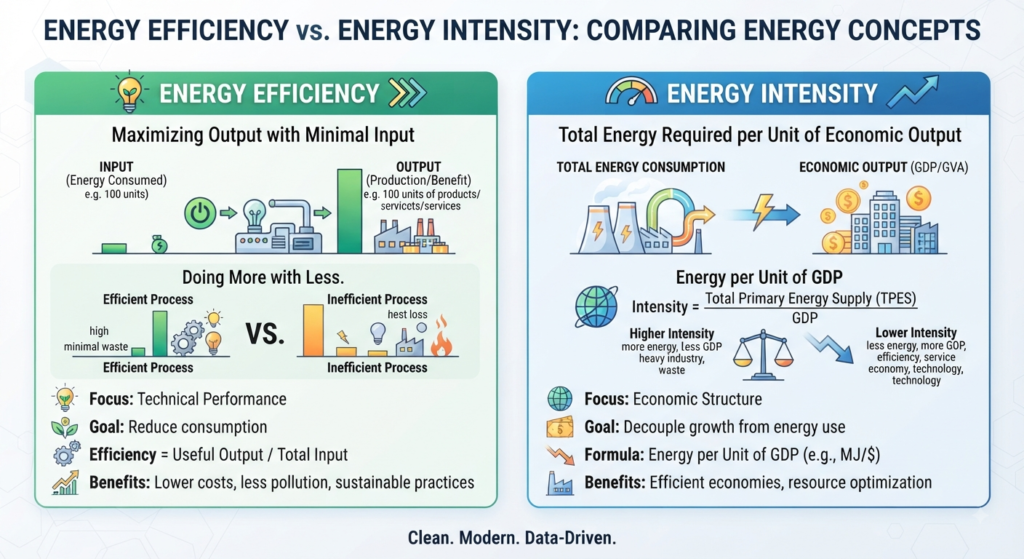
The main difference between Energy Efficiency vs. Energy Intensity is that energy efficiency describes how effectively energy is used to provide a desired service, output, or function, while energy intensity measures how much energy is consumed to produce a unit of output, activity, or economic value. Energy efficiency is therefore primarily a performance and technology concept, whereas energy intensity is an energy-use indicator used to evaluate and compare performance.

Understanding Energy Efficiency vs. Energy Intensity is important because the two terms are closely related but should not be treated as identical. Improving equipment, processes, and operating practices can increase energy efficiency and often reduce energy intensity. However, energy intensity can also change because of factors such as production mix, weather, operating conditions, product quality, capacity utilization, or structural changes in an organization.

Table of Contents

Energy Efficiency vs. Energy Intensity Comparison Table

The table below highlights the major differences between Energy Efficiency vs. Energy Intensity.

Feature Energy Efficiency Energy Intensity
Definition How effectively energy is used to provide a desired output or service Energy consumed per unit of output, activity, or economic value
Main Focus Performance of equipment, systems, or processes Relationship between energy consumption and output
Primary Objective Deliver the same or better service with less energy Measure and track energy use relative to an activity or output
Typical Measurement Efficiency ratio or performance indicator Energy per unit of output
Common Units %, kWh/unit, kWh/m², efficiency ratio kWh/tonne, GJ/tonne, kWh/m², MJ/unit
Direction of Improvement Higher efficiency is generally better Lower intensity is generally better
Application Motors, boilers, pumps, buildings, processes Plants, industries, buildings, transport, economies
Influenced By Equipment design, operating conditions, controls, maintenance Energy use, production level, product mix, operating conditions
Typical Example A motor converts electrical input into mechanical output efficiently A cement plant consumes 85 kWh per tonne of cement
Main Use Improve technical performance Benchmark and monitor energy performance
Relationship Can improve through technology and operational measures Often decreases when energy efficiency improves
Key Question How effectively is energy being used? How much energy is being used per unit of activity?
Energy Efficiency vs. Energy Intensity

What Is Energy Efficiency?

Energy efficiency refers to the ability of a system, machine, process, building, or organization to provide a required output or service while using energy effectively.

In simple terms:

Energy Efficiency → Useful Output from Energy Input

For example, consider two electric motors that provide the same mechanical output. If one motor requires less electrical input to produce that output, it is more energy efficient.

Energy efficiency can be improved through:

  • High-efficiency motors
  • Variable frequency drives
  • Efficient pumps and fans
  • Improved insulation
  • Heat recovery
  • Process optimization
  • Automatic controls
  • Reduced losses
  • Preventive maintenance
  • Energy management systems
  • Improved operating practices

Energy efficiency does not necessarily mean reducing production or reducing the level of service. The objective is to achieve the required result with less energy input.

Examples of Energy Efficiency

A few practical examples include:

Efficient Motor

Replacing an inefficient motor with a high-efficiency motor can reduce electrical losses while maintaining the same mechanical output.

Efficient Pump

Selecting a pump that operates close to its best efficiency point can reduce the electrical energy required to deliver the required flow and head.

Building Insulation

Improving building insulation can reduce heating or cooling requirements while maintaining indoor comfort.

Waste Heat Recovery

Recovering heat that would otherwise be rejected can reduce the amount of additional fuel required by a process.

What Is Energy Intensity?

Energy intensity is a measure of the amount of energy consumed for a defined unit of output, activity, floor area, economic value, or other measurable basis.

A simple representation is:

Energy Intensity=Energy ConsumptionRelevant Output or Activity\text{Energy Intensity} = \frac{\text{Energy Consumption}}{\text{Relevant Output or Activity}}

For an industrial plant, energy intensity might be expressed as:

kWh/m2/year\text{kWh/m}^2\text{/year}

It may be expressed for a commercial building as:

kWh/m2/year\text{kWh/m}^2\text{/year}

For a transport system, an indicator might be expressed as:

MJ/passenger-km\text{MJ/passenger-km}

The appropriate denominator depends on the purpose of the analysis.

Examples of Energy Intensity

Examples include:

  • kWh per tonne of cement
  • kWh per tonne of steel
  • GJ per tonne of product
  • kWh per square metre of building area
  • Litres of fuel per 100 km
  • Energy per passenger-kilometre
  • Energy consumption per unit of economic output

A lower energy intensity generally indicates that less energy is required for each unit of the selected activity or output.

Energy Efficiency vs. Energy Intensity: Key Differences

1. Meaning

The primary difference between Energy Efficiency vs. Energy Intensity is what each term describes.

Energy efficiency focuses on how effectively energy is converted or used to deliver a desired service or output.

Energy intensity focuses on how much energy is consumed for a specified quantity of output or activity.

Therefore:

Key Difference:

Energy Efficiency → How effectively energy is used

Energy Intensity → How much energy is used per unit of output

2. Main Focus

Energy efficiency is usually concerned with the performance of a system or technology.

Typical questions include:

  • How efficiently is this motor operating?
  • How much useful heat is obtained from the fuel?
  • How effectively does the pump convert electrical input into hydraulic output?
  • Can the same production be achieved with less energy?

Energy intensity takes a broader measurement perspective:

  • How many kWh are required per tonne?
  • How much energy does this building consume per square metre?
  • How much fuel is used per kilometre?
  • How much energy is consumed per unit of economic activity?

3. Measurement

Energy efficiency is often expressed as a percentage, ratio, or equipment-specific performance indicator.

For example:

Efficiency=Useful Energy OutputEnergy Input×100\text{Efficiency} = \frac{\text{Useful Energy Output}}{\text{Energy Input}} \times 100

Energy intensity uses energy consumption divided by a relevant denominator.

For example:

Energy Intensity=Energy ConsumedProduction Output\text{Energy Intensity} = \frac{\text{Energy Consumed}}{\text{Production Output}}

This difference in measurement is important because efficiency and intensity are not simply two names for the same calculation.

4. Direction of Improvement

For energy efficiency:

Higher efficiency → Generally better

For energy intensity:

Lower intensity → Generally better

For example, if a motor’s efficiency increases from 88% to 94%, its technical energy performance has improved.

If a factory’s energy intensity falls from 95 kWh/tonne to 82 kWh/tonne, less energy is being consumed for each tonne of output.

5. Equipment-Level vs. System-Level Perspective

Energy efficiency is frequently used at the equipment or process level.

Examples include:

  • Motor efficiency
  • Boiler efficiency
  • Compressor efficiency
  • Pump efficiency
  • Furnace efficiency
  • Chiller efficiency

Energy intensity is often used at the facility, production, sector, or organizational level.

Examples include:

  • Plant energy intensity
  • Cement energy intensity
  • Building energy intensity
  • Transport energy intensity
  • Industrial sector energy intensity

However, both concepts can be applied at different levels depending on the chosen methodology.

6. Role of Production

Energy intensity is strongly influenced by the relationship between energy consumption and production.

Suppose an industrial plant consumes 10,000 MWh of energy.

If it produces 100,000 tonnes:

Energy Intensity=10,000,000100,000=100 kWh/tonne\text{Energy Intensity} = \frac{10,000,000}{100,000} = 100\ \text{kWh/tonne}

If the same plant produces 125,000 tonnes while using the same amount of energy:

Energy Intensity=10,000,000125,000=80 kWh/tonne\text{Energy Intensity} = \frac{10,000,000}{125,000} = 80\ \text{kWh/tonne}

The plant’s energy intensity has improved from 100 kWh/tonne to 80 kWh/tonne.

However, this does not necessarily mean that every individual machine became more energy efficient. Higher utilization or changes in operating conditions may also have contributed.

This is an important distinction between energy efficiency and energy intensity.

7. Impact of Capacity Utilization

A plant operating at low capacity may have a higher energy intensity because some energy consumption remains relatively fixed even when production decreases.

For example:

  • Lighting continues to operate.
  • Cooling systems may continue running.
  • Compressors may operate at minimum load.
  • Fans and pumps may have base-load consumption.
  • Auxiliary systems may consume energy regardless of production.

When production increases while fixed energy consumption remains relatively stable, energy intensity can decrease.

Therefore, energy intensity should be interpreted in the context of production level and operating conditions.

8. Influence of Product Mix

Energy intensity can also change because the product being manufactured changes.

A product requiring a high-temperature process may consume significantly more energy than another product manufactured in the same facility.

Therefore:

Change in Energy Intensity ≠ Always Change in Energy Efficiency

A change in product mix can increase or decrease energy intensity even when equipment efficiency remains relatively unchanged.

Relationship Between Energy Efficiency and Energy Intensity

Energy efficiency and energy intensity are closely connected.

A useful way to understand their relationship is:

Energy Efficiency Improvement → Lower Energy Consumption → Lower Energy per Unit of Output → Lower Energy Intensity

For example:

Efficient Motor → Lower Motor Losses → Lower Electricity Consumption → Lower Plant Energy Intensity

However, the relationship is not always direct because energy intensity is affected by many factors beyond equipment efficiency.

These may include:

  • Production volume
  • Product mix
  • Weather
  • Operating hours
  • Process conditions
  • Equipment utilization
  • Raw-material characteristics
  • Maintenance condition
  • Plant configuration
  • Auxiliary energy consumption

Therefore, energy intensity is best interpreted together with operational and technical information.

Energy Efficiency vs. Energy Intensity in Industry

Industrial facilities commonly use both indicators.

Energy efficiency can be evaluated for individual equipment and processes, while energy intensity can be used as a plant-level KPI.

For example, a cement plant may monitor:

  • Motor efficiency
  • Fan efficiency
  • Pump efficiency
  • Compressor efficiency
  • Kiln efficiency
  • Heat-recovery efficiency
  • Electrical system losses
  • Specific power consumption
  • Thermal energy consumption per tonne

A typical industrial improvement pathway may be:

Energy Audit → Identify Losses → Improve Equipment Efficiency → Optimize Processes → Reduce Energy Consumption → Lower Energy Intensity

This approach allows engineers to connect equipment-level improvements with plant-level performance.

Energy Efficiency vs. Energy Intensity in Buildings

For buildings, energy intensity is frequently used to compare energy consumption relative to floor area.

For example:

Building Energy Intensity=Annual Energy ConsumptionFloor Area\text{Building Energy Intensity} = \frac{\text{Annual Energy Consumption}}{\text{Floor Area}}

A building consuming 600,000 kWh annually with a floor area of 10,000 m² would have:

Energy Intensity=600,00010,000=60 kWh/m2/year\text{Energy Intensity} = \frac{600,000}{10,000} = 60\ \text{kWh/m}^2\text{/year}

Energy efficiency measures that can reduce building energy intensity include:

  • LED lighting
  • Efficient air-conditioning
  • Building insulation
  • Efficient pumps and fans
  • Variable-speed drives
  • Building automation
  • Improved ventilation control
  • Solar shading
  • Energy-efficient appliances

Energy Efficiency vs. Energy Intensity in Transportation

Transportation provides another useful example.

Energy efficiency can describe how effectively a vehicle converts fuel or electricity into useful movement.

Energy intensity can describe energy consumption relative to distance or transport service.

Examples include:

  • MJ/km
  • kWh/km
  • L/100 km
  • MJ/passenger-km
  • MJ/tonne-km

A more efficient vehicle may require less energy to travel the same distance.

However, overall transport energy intensity can also depend on:

  • Vehicle occupancy
  • Load factor
  • Traffic conditions
  • Driving behavior
  • Route characteristics
  • Vehicle size
  • Average speed

Therefore, technical vehicle efficiency and system-level energy intensity should be evaluated separately.

Why Energy Intensity Is an Important KPI

Energy intensity is widely used as a performance indicator because it allows energy consumption to be normalized against a meaningful activity or output.

It can help organizations:

  • Track energy performance
  • Compare different periods
  • Benchmark facilities
  • Identify abnormal consumption
  • Set energy-reduction targets
  • Evaluate energy-saving projects
  • Support energy-management programs
  • Monitor production-normalized performance

For example:

Baseline Energy Intensity → Energy Improvement Project → New Energy Intensity → Performance Comparison

This provides a practical way to determine whether energy consumption is improving relative to production or activity.

Why Energy Efficiency Is Important

Improving energy efficiency can provide benefits beyond lower energy consumption.

Reduced Operating Cost

Using less energy for the same output can reduce utility and fuel costs.

Lower Equipment Losses

Efficient equipment generally wastes less energy as heat, friction, pressure loss, or other losses.

Reduced Emissions

Lower energy consumption can reduce associated greenhouse-gas emissions, particularly where fossil-fuel energy is involved.

Improved Equipment Performance

Efficient operation can improve process stability and reduce unnecessary loading.

Reduced Infrastructure Demand

Lower energy demand can reduce the required capacity of electrical, mechanical, and thermal systems.

Improved Competitiveness

Lower energy consumption per unit of product can improve the cost position of energy-intensive industries.

Common Mistakes When Comparing Energy Efficiency and Energy Intensity

Several common mistakes can lead to incorrect conclusions.

Mistake 1: Treating Them as Identical

Energy efficiency and energy intensity are related but measure different aspects of energy performance.

Mistake 2: Assuming Lower Energy Intensity Always Means Better Equipment Efficiency

A lower energy intensity may result from higher production, improved utilization, product-mix changes, or other factors.

Mistake 3: Ignoring Production Conditions

Comparing energy intensity between two periods without considering production levels can produce misleading results.

Mistake 4: Using an Inappropriate Denominator

The denominator should represent a meaningful output or activity.

For example, comparing energy per tonne may not be appropriate if product characteristics change substantially.

Mistake 5: Ignoring Auxiliary Energy

Plant-level energy intensity should account for relevant auxiliary systems such as pumps, fans, compressors, lighting, and material-handling equipment.

Mistake 6: Looking Only at Efficiency Percentage

High equipment efficiency does not automatically guarantee low overall energy intensity. System design, operating conditions, and process integration also matter.

How to Improve Energy Efficiency and Reduce Energy Intensity

A structured energy-management approach can address both objectives.

Step 1: Establish the Baseline

Collect reliable energy and production data.

Step 2: Identify Major Energy Consumers

Determine which equipment, processes, and utilities account for the largest energy consumption.

Step 3: Evaluate Equipment Efficiency

Check motors, pumps, fans, compressors, boilers, furnaces, chillers, and other major energy-consuming equipment.

Step 4: Optimize Operating Conditions

Avoid unnecessary idling, throttling, excessive pressure, overcooling, overheating, and operation away from efficient operating points.

Step 5: Improve Process Integration

Use waste heat recovery, process optimization, and improved material or energy flows where technically feasible.

Step 6: Monitor Energy Intensity

Track energy consumption against production or another appropriate activity indicator.

Step 7: Verify Savings

Compare actual performance with the baseline while accounting for changes in production and operating conditions.

Step 8: Continue Improvement

Use energy-management systems, monitoring, audits, and performance indicators to identify additional opportunities.

Energy Efficiency vs. Energy Intensity: Simple Example

Consider a manufacturing plant that consumes 12,000 MWh of electricity and produces 120,000 tonnes of product.

Its energy intensity is:

Energy Intensity=12,000,000120,000=100 kWh/tonne\text{Energy Intensity} = \frac{12,000,000}{120,000} = 100\ \text{kWh/tonne}

The plant then introduces several energy-efficiency measures, including improved motor systems, process optimization, and variable-speed drives.

After implementation, annual electricity consumption falls to 10,800 MWh, while production remains at 120,000 tonnes.

The new energy intensity becomes:

Energy Intensity=10,800,000120,000=90 kWh/tonne\text{Energy Intensity} = \frac{10,800,000}{120,000} = 90\ \text{kWh/tonne}

The reduction from 100 kWh/tonne to 90 kWh/tonne indicates improved energy performance.

In this case, the reduction in energy intensity is directly associated with lower energy consumption at the same production level.

Energy Efficiency vs. Energy Intensity: Which Is More Important?

Neither measure should be considered more important in every situation.

Energy efficiency is particularly useful for identifying and improving the performance of individual technologies, machines, and processes.

Energy intensity is particularly useful for measuring overall energy performance relative to production, activity, or economic output.

For industrial energy management, the strongest approach is to use both:

Equipment Efficiency → Process Efficiency → Energy Consumption → Energy Intensity

This provides a link between technical improvements and overall organizational performance.

Energy Efficiency vs. Energy Intensity and Decarbonization

Both indicators can support a broader energy transition and decarbonization strategy.

Improving energy efficiency reduces the amount of energy required to deliver the same output. Lower energy demand can make electrification and renewable-energy integration easier.

A simplified pathway is:

Energy Efficiency → Lower Energy Demand → Lower Energy Consumption → Reduced Fossil-Fuel Use → Lower Emissions → Decarbonization

Energy intensity can then be used as a KPI to monitor progress.

For example:

Baseline Energy Intensity → Efficiency Improvements → Renewable Energy Integration → Lower Energy Intensity → Lower Energy-Related Emissions

However, reducing energy intensity alone does not guarantee proportional emissions reductions. The carbon intensity of the energy supply must also be considered.

Conclusion

The comparison of Energy Efficiency vs. Energy Intensity shows that the two concepts are closely related but serve different purposes. Energy efficiency describes how effectively energy is used to deliver a desired output or service, while energy intensity measures the amount of energy consumed relative to a defined output, activity, or economic indicator.

Energy efficiency is commonly used to evaluate equipment and process performance, whereas energy intensity is particularly useful for benchmarking, monitoring, and comparing overall energy performance.

A reduction in energy intensity can result from improved energy efficiency, but it can also be influenced by production volume, capacity utilization, product mix, weather, and other operational factors. Therefore, energy intensity should always be interpreted in context.

For effective energy management, organizations should use both measures:

Improve Energy Efficiency → Reduce Energy Consumption → Monitor Energy Intensity → Verify Performance → Continue Improvement

Together, energy efficiency and energy intensity provide a stronger basis for reducing operating costs, improving industrial performance, lowering energy demand, and supporting long-term decarbonization.

Frequently Asked Questions (FAQs)

Q1. What is the difference between energy efficiency and energy intensity?

Energy efficiency measures how effectively energy is used to provide a desired output or service, while energy intensity measures energy consumption per unit of output, activity, or economic value.

Q2. Is lower energy intensity better?

Generally, yes. A lower energy intensity means less energy is being consumed for each unit of the selected output or activity. However, the reason for the reduction should be investigated before concluding that technical efficiency has improved.

Q3. Is higher energy efficiency better?

Generally, yes. Higher efficiency means a greater proportion of the input energy is converted into useful output or service.

Q4. Can energy efficiency improve without reducing energy intensity?

Yes. Equipment efficiency can improve while overall energy intensity remains unchanged or even increases if production conditions, product mix, or other factors change significantly.

Q5. How is energy intensity calculated?

Energy intensity is calculated by dividing energy consumption by a relevant output or activity, such as tonnes of product, floor area, distance travelled, or economic output.

Read Next:

Net Zero Energy vs. Net Zero Emissions: What’s the Difference?

The main difference between Net Zero Energy vs. Net Zero Emissions is that Net Zero Energy focuses on balancing the amount of energy consumed with renewable or low-carbon energy generated, while Net Zero Emissions focuses on balancing greenhouse-gas emissions released into the atmosphere with emissions removed or otherwise neutralized. Net Zero Energy is therefore primarily an energy-balance concept, whereas Net Zero Emissions is an emissions and climate-balance concept.

Understanding Net Zero Energy vs. Net Zero Emissions is important because the two terms are closely related but are not interchangeable. A building, facility, or organization can achieve a net-zero energy balance while still producing greenhouse-gas emissions from fossil fuels or other sources. Net Zero Energy can support decarbonization, but achieving Net Zero Emissions generally requires a broader strategy covering energy, fuels, industrial processes, transportation, and other sources of greenhouse gases.

Table of Contents

Net Zero Energy vs. Net Zero Emissions Comparison Table

The table below highlights the major differences between Net Zero Energy vs. Net Zero Emissions.

FeatureNet Zero EnergyNet Zero Emissions
DefinitionEnergy consumed is balanced by renewable or low-carbon energy generatedGreenhouse-gas emissions are balanced by removals or other permitted measures
Main FocusEnergy consumption and generationGreenhouse-gas emissions
Primary ObjectiveAchieve a net energy balanceAchieve a net-zero emissions balance
MeasurementUsually measured in energy units such as kWh or MWhUsually measured in CO₂-equivalent emissions
Renewable EnergyUsually a major componentImportant but not always sufficient by itself
Energy EfficiencyCentral to reducing energy demandImportant for reducing emissions
Fossil FuelsMay still be used in some circumstancesMust be substantially reduced or addressed
Carbon RemovalNot necessarily requiredMay be required for residual emissions
ScopeOften applied to buildings, facilities, and energy systemsCan apply to organizations, sectors, countries, and economies
Typical ExampleA building generates as much renewable energy annually as it consumesAn organization reduces emissions and balances remaining emissions through appropriate removals
Primary IndicatorNet annual energy balanceNet greenhouse-gas emissions
RelationshipCan contribute to decarbonizationRepresents a broader climate objective
Net Zero Energy vs. Net Zero Emissions

What Is Net Zero Energy?

Net Zero Energy is a condition in which the energy consumed by a building, facility, or system over a defined period is balanced by renewable or low-carbon energy generated.

A simple representation is:

Net Energy:

Net Energy = Energy Consumed − Renewable Energy Generated

When the result is approximately zero, the system can be described as having a net-zero energy balance, subject to the applicable definition and accounting boundary.

For example, suppose a building consumes 100,000 kWh of electricity during a year and generates 100,000 kWh from its solar PV system.

Net Energy = 100,000 − 100,000 = 0 kWh

The building has achieved an annual energy balance under this simplified example.

Characteristics of Net Zero Energy

Some important characteristics include:

  • Focuses primarily on energy consumption and generation.
  • Emphasizes energy efficiency.
  • Usually involves renewable-energy generation.
  • Can be applied to buildings, campuses, facilities, and energy systems.
  • Is commonly evaluated over a defined period, such as one year.
  • Uses energy units such as kWh, MWh, or GJ.
  • Can involve onsite renewable generation or eligible renewable energy supplied through other arrangements.
  • Requires measurement of actual energy consumption and generation.

What Is Net Zero Emissions?

Net Zero Emissions refers to achieving a balance between greenhouse-gas emissions released into the atmosphere and greenhouse-gas removals or other measures recognized under the applicable framework.

Unlike Net Zero Energy, the primary concern is not the amount of energy consumed but the greenhouse gases associated with economic and energy activities.

Emissions can come from sources such as:

  • Coal
  • Natural gas
  • Petroleum fuels
  • Industrial processes
  • Transportation
  • Agriculture
  • Waste
  • Refrigerants
  • Methane emissions
  • Other greenhouse-gas sources

A net-zero emissions strategy therefore requires substantial reductions in emissions before addressing remaining residual emissions.

Characteristics of Net Zero Emissions

Important characteristics include:

  • Focuses on greenhouse-gas emissions.
  • Usually uses CO₂-equivalent (CO₂e) as the measurement unit.
  • Requires substantial emissions reduction.
  • Covers more than electricity consumption.
  • Can include direct and indirect emissions depending on the defined boundary.
  • May require carbon removals for residual emissions.
  • Can be applied to companies, buildings, industries, sectors, and countries.
  • Requires emissions measurement, reporting, and verification.

Net Zero Energy vs. Net Zero Emissions: Key Differences

1. Meaning

The primary difference between Net Zero Energy vs. Net Zero Emissions is their meaning.

Net Zero Energy means that energy consumed is balanced by renewable or low-carbon energy generated over the defined accounting period.

Net Zero Emissions means that greenhouse-gas emissions are reduced substantially and remaining emissions are balanced by appropriate removals or other recognized measures.

Therefore:

Key Difference:

Net Zero Energy → Energy Balance
Net Zero Emissions → Greenhouse-Gas Balance

2. Main Focus

Net Zero Energy focuses on energy.

The main questions are:

  • How much energy is consumed?
  • How efficiently is it used?
  • How much renewable energy is generated?
  • Is annual energy consumption balanced by renewable generation?

Net Zero Emissions focuses on greenhouse gases.

The questions become:

  • How much CO₂e is emitted?
  • Where do the emissions originate?
  • How can emissions be reduced?
  • What residual emissions remain?
  • How are unavoidable residual emissions addressed?

3. Measurement

Another important difference between Net Zero Energy vs. Net Zero Emissions is measurement.

Net Zero Energy is commonly expressed using energy units such as:

kWh, MWh, GJ, or other energy units

Net Zero Emissions is commonly expressed using:

kg CO₂e or tonnes CO₂e

This means that a net-zero energy calculation and a net-zero emissions calculation are measuring different things.

4. Role of Renewable Energy

Renewable energy plays a central role in achieving Net Zero Energy.

For example, solar PV can generate electricity to offset electricity consumed by a building.

Renewable energy is also important for Net Zero Emissions because replacing fossil-fuel electricity with renewable electricity can significantly reduce associated greenhouse-gas emissions.

However, renewable electricity alone may not eliminate all emissions.

5. Role of Energy Efficiency

Energy efficiency is important for both concepts.

For Net Zero Energy, efficiency reduces the amount of energy that needs to be balanced by renewable generation.

For Net Zero Emissions, efficiency reduces energy-related emissions and can make the transition to low-carbon energy easier.

A typical sequence is:

Net Zero Energy Pathway:

Energy Audit → Energy Efficiency → Electrification → Renewable Energy → Energy Storage → Monitoring

6. Treatment of Fossil Fuels

A facility may potentially achieve a net-zero energy balance while still using some fossil fuels, depending on the specific definition and accounting boundary.

For example, a facility could consume electricity and natural gas while generating enough eligible renewable energy to achieve a defined energy balance.

However, continued fossil-fuel use generally creates greenhouse-gas emissions. Therefore, achieving Net Zero Emissions requires those emissions to be substantially reduced or otherwise addressed.

This is one of the most important distinctions between Net Zero Energy vs. Net Zero Emissions.

7. Carbon Removal

Carbon removal is not inherently required to achieve a net-zero energy balance.

Net Zero Emissions, however, may involve addressing residual emissions that cannot reasonably be eliminated through efficiency, electrification, renewable energy, or other reduction measures.

The basic principle is therefore:

Reduce Emissions First → Minimize Residual Emissions → Address Remaining Emissions

8. Scope

Net Zero Energy is often used for:

  • Buildings
  • Homes
  • Campuses
  • Industrial facilities
  • Energy systems

Net Zero Emissions has a broader application and can refer to:

  • Companies
  • Industries
  • Cities
  • Countries
  • Energy systems
  • Transport systems
  • Global emissions

Therefore, Net Zero Emissions generally has a broader emissions boundary than a specific Net Zero Energy project.

9. Environmental Objective

The ultimate objective of Net Zero Energy is to achieve a balanced energy system with high energy efficiency and renewable-energy integration.

The objective of Net Zero Emissions is to achieve a balance between greenhouse-gas emissions and removals in order to support long-term climate goals.

Consequently, Net Zero Energy can be considered one possible component of a broader decarbonization strategy.

10. Can One Be Achieved Without the Other?

Yes.

A facility may achieve Net Zero Energy without achieving Net Zero Emissions if it continues to produce significant emissions from fossil fuels or industrial processes.

Similarly, an organization may pursue Net Zero Emissions without every individual facility being Net Zero Energy. It can reduce emissions through renewable electricity procurement, electrification, efficiency improvements, low-carbon fuels, and other measures.

Therefore, the two concepts overlap but are not identical.

Relationship Between Net Zero Energy and Net Zero Emissions

The relationship between Net Zero Energy vs. Net Zero Emissions can be understood as a connection between energy management and emissions reduction.

A simplified pathway is:

Net Zero Emissions Pathway:

Energy Efficiency → Lower Energy Demand → Renewable Energy → Lower Fossil-Fuel Use → Lower Emissions → Net Zero Emissions

Net Zero Energy can therefore contribute significantly to net-zero decarbonization, particularly where energy consumption is responsible for a large share of greenhouse-gas emissions.

For example:

Efficient Building → Lower Electricity Demand → Solar PV → Reduced Grid Electricity → Lower Fossil-Fuel Generation → Lower CO₂ Emissions

However, achieving a net-zero energy balance does not automatically eliminate emissions from all activities.

Similarities Between Net Zero Energy and Net Zero Emissions

Although Net Zero Energy vs. Net Zero Emissions describes two different concepts, they have several important similarities.

Some major similarities include:

  • Both aim to reduce environmental impact.
  • Both encourage energy efficiency.
  • Both can involve renewable energy.
  • Both require measurement and monitoring.
  • Both can support decarbonization.
  • Both require defined boundaries and accounting methods.
  • Both can be applied to buildings and organizations.
  • Both encourage reduction of fossil-fuel dependence.
  • Both require long-term planning.
  • Both can benefit from digital energy-management technologies.

The strongest connection is that reducing energy consumption and replacing fossil-fuel energy with renewable energy can simultaneously improve energy performance and reduce greenhouse-gas emissions.

Net Zero Energy vs. Net Zero Emissions in Buildings

Buildings provide a useful example of the difference.

A building can target Net Zero Energy by reducing energy consumption and generating sufficient renewable energy, such as rooftop solar, to balance its annual energy use.

A building targeting Net Zero Emissions needs to consider a broader range of emissions, potentially including:

  • Electricity-related emissions
  • Natural-gas consumption
  • Fuel consumption
  • Refrigerant emissions
  • Other relevant direct and indirect emissions
  • Embodied emissions, depending on the selected framework and scope

Thus, a building can have a strong Net Zero Energy performance while still requiring additional measures to achieve a broader net-zero emissions objective.

Net Zero Energy vs. Net Zero Emissions in Industry

The distinction becomes even more important in industrial facilities.

Industrial emissions can originate from both energy use and process activities.

A practical industrial strategy may include:

Industrial Net Zero Energy Pathway:

Energy Audit → Process Optimization → Efficient Motors → VFDs → Waste Heat Recovery → Electrification → Renewable Power → Energy Storage → Digital Monitoring

These measures can reduce energy consumption and energy-related emissions.

However, some industries also have process emissions that cannot be eliminated simply by switching to renewable electricity. Such emissions require additional technologies and strategies, depending on the industry.

Therefore, industrial Net Zero Emissions is generally broader than simply achieving a Net Zero Energy balance.

Net Zero Energy vs. Net Zero Emissions: Which Is More Comprehensive?

Neither concept should be considered a replacement for the other because they address different objectives.

Net Zero Energy provides a useful framework for improving energy efficiency and balancing energy consumption with renewable or low-carbon energy.

Net Zero Emissions provides a broader framework for reducing and ultimately balancing greenhouse-gas emissions across relevant activities.

In simple terms:

Key Difference:

Net Zero Energy → Energy-focused
Net Zero Emissions → Emissions-focused

A facility can use Net Zero Energy as one part of its overall net zero emissions pathway.

Net Zero Energy vs. Net Zero Emissions: Simple Example

Consider a factory that consumes:

  • 1,000 MWh of electricity
  • 500 MWh equivalent of natural-gas energy

Suppose the factory generates 1,000 MWh of renewable electricity.

The renewable electricity may balance the electricity consumption, but the factory still uses natural gas. That natural-gas consumption can result in greenhouse-gas emissions.

Therefore, the factory could have a strong renewable-energy or energy-balance performance while still needing additional measures to reduce its greenhouse-gas emissions.

A broader net-zero strategy could include:

Net Zero Emissions Pathway:

Energy Efficiency → Electrification → Renewable Electricity → Low-Carbon Fuels → Process Emission Reduction → Residual Emission Management

How to Move From Net Zero Energy Toward Net Zero Emissions

Organizations seeking to move beyond energy balance toward broader emissions reduction can follow a structured approach:

Step 1: Establish the Baseline

Measure energy consumption and greenhouse-gas emissions.

Step 2: Improve Energy Efficiency

Reduce unnecessary energy consumption through efficient equipment and process optimization.

Step 3: Increase Renewable Energy

Install solar PV, procure renewable electricity, or use other appropriate renewable-energy sources.

Step 4: Electrify Suitable Loads

Replace fossil-fuel equipment with efficient electrical alternatives where technically feasible.

Step 5: Address Process Emissions

Identify emissions that are not directly related to electricity or energy consumption.

Step 6: Use Low-Carbon Fuels

Hydrogen, sustainable biofuels, biogas, and other low-emission fuels may have a role in difficult-to-electrify applications.

Step 7: Address Residual Emissions

For emissions that cannot be eliminated, appropriate carbon-removal or other recognized measures may need to be considered according to the applicable framework.

Step 8: Monitor and Verify

Regularly measure energy consumption, renewable generation, and greenhouse-gas emissions against established targets.

Which Is Better: Net Zero Energy or Net Zero Emissions?

It is not accurate to say that one is universally better because they address different goals.

Net Zero Energy is particularly useful when the objective is to improve energy efficiency and balance energy consumption with renewable generation.

Net Zero Emissions is more comprehensive when the objective is to address greenhouse-gas emissions across an organization, facility, sector, or economy.

For many organizations, the most effective approach is to use Net Zero Energy as one component of a broader Net Zero Emissions strategy.

Conclusion

The comparison of Net Zero Energy vs. Net Zero Emissions shows that the two concepts are closely connected but fundamentally different. Net Zero Energy focuses on balancing energy consumption with renewable or low-carbon energy generation, while Net Zero Emissions focuses on reducing greenhouse-gas emissions and balancing remaining emissions with appropriate removals or other recognized measures.

Net Zero Energy can contribute to decarbonization by reducing energy demand, increasing renewable energy, and reducing dependence on fossil fuels. However, it does not automatically eliminate emissions from fossil fuels, industrial processes, transportation, or other sources.

Therefore, organizations pursuing a long-term net zero emissions pathway should consider Net Zero Energy as part of a wider strategy that combines energy efficiency, renewable energy, electrification, low-carbon fuels, process-emission reduction, energy storage, and responsible management of residual emissions.

Frequently Asked Questions (FAQs)

Q1. What is the main difference between Net Zero Energy and Net Zero Emissions?

The main difference between Net Zero Energy vs. Net Zero Emissions is that Net Zero Energy focuses on balancing energy consumption with renewable or low-carbon energy generation, while Net Zero Emissions focuses on balancing greenhouse-gas emissions with appropriate removals or other recognized measures.

Q2. Is Net Zero Energy the same as Net Zero Emissions?

No. They are related but not identical. Net Zero Energy focuses on energy balance, while Net Zero Emissions focuses on greenhouse-gas emissions.

Q3. Can a building achieve Net Zero Energy but not Net Zero Emissions?

Yes. A building may achieve an annual net energy balance while still producing emissions from natural gas, refrigerants, or other sources, depending on the defined boundary.

Q4. Does renewable energy help achieve both Net Zero Energy and Net Zero Emissions?

Yes. Renewable energy can help balance energy consumption and can also reduce emissions associated with fossil-fuel-based energy.

Q5. Why is energy efficiency important for both concepts?

Energy efficiency reduces the amount of energy required and therefore can reduce both renewable-energy requirements and energy-related greenhouse-gas emissions.

Read Next:

  1. Energy vs Power
  2. Energy Transformation: Meaning, Types & Examples
  3. Law of Energy Conservation: Definition, Formula, Explanation & Examples
  4. Wind Energy vs Solar Energy
  5. What Are Fossil Fuels? Types, Formation, Uses, and Environmental Effects
  6. 13 Advantages and Disadvantages of Biomass Energy
  7. Net Zero Energy: Meaning, Benefits, Pathway, and Role in Decarbonization
  8. Energy Density: Definition, Formula, Types, Units, Examples and Applications
  9. Energy Efficiency vs. Energy Intensity

Leave a Comment