Solar insolation is the amount of solar energy that reaches the Earth’s surface or atmosphere as electromagnetic radiation from the Sun. It is a fundamental source of energy that drives the Earth’s climate system, weather patterns, and many natural processes.
The Earth continuously receives solar radiation and absorbs a portion of it. To maintain an overall energy balance, the planet releases energy back into space as terrestrial infrared radiation. The balance between incoming solar energy and outgoing heat plays a major role in determining Earth’s average temperature and climate.
What is Solar Insolation?
Solar insolation refers to the solar radiation received by the Earth from the Sun. It consists primarily of shortwave electromagnetic radiation, including ultraviolet, visible light, and near-infrared wavelengths.
Although only a small portion of the Sun’s total energy reaches Earth, this incoming solar radiation is fundamental to the planet’s energy system. It provides the energy that drives weather and climate processes, supports photosynthesis and other biological activities, and helps regulate Earth’s overall heat balance.
Factors Affecting Solar Insolation
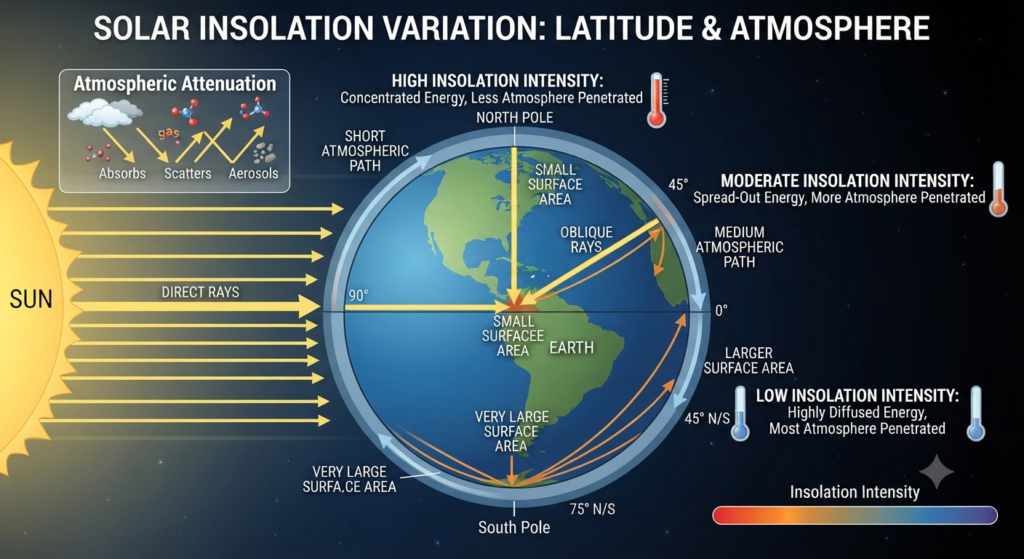
Solar insolation is not uniform across the Earth. The amount of solar energy received at a particular location changes with time, latitude, season, atmospheric conditions, and the angle at which sunlight reaches the surface. The major factors affecting solar insolation are described below.
1. Earth’s Rotation
The Earth rotates on its axis approximately once every 24 hours. This rotation creates the cycle of day and night.
During daylight, a location receives solar radiation, while during nighttime it receives no direct sunlight. As a result, solar insolation changes continuously throughout the day, generally reaching its highest level around solar noon under clear-sky conditions.
2. Earth’s Axial Tilt
Earth’s rotational axis is tilted by approximately 23.4° relative to the perpendicular to its orbital plane. This tilt is one of the main reasons for the occurrence of seasons.
As Earth moves around the Sun, the tilt changes the angle and duration of sunlight received by the Northern and Southern Hemispheres. Consequently, solar insolation varies between seasons and between different latitudes.
3. Earth’s Revolution Around the Sun
Earth completes one revolution around the Sun in approximately one year. Its orbit is slightly elliptical, so the Earth–Sun distance changes during the year.
The combination of Earth’s revolution and axial tilt affects the duration and angle of sunlight received at different locations, contributing to seasonal variations in solar insolation.
4. Angle of Incidence of Sunlight
The angle at which solar rays strike the Earth’s surface has a major influence on the intensity of insolation.
When sunlight reaches the surface more directly, its energy is concentrated over a relatively small area. When the rays arrive at a lower angle, the same energy is distributed over a larger surface area.
Therefore:
More Direct Sunlight → Higher Energy Concentration → Greater Insolation per Unit Area
Oblique Sunlight → Greater Area Covered → Lower Insolation per Unit Area
This is one reason why tropical regions generally receive more concentrated solar energy than polar regions.
5. Atmospheric Conditions
The atmosphere can significantly modify the amount of solar radiation that reaches the Earth’s surface. Clouds, dust, aerosols, water vapour, and atmospheric gases can absorb, reflect, or scatter incoming solar radiation.
Consequently, a clear atmosphere generally allows more solar radiation to reach the ground, while heavy cloud cover or high concentrations of atmospheric particles can reduce surface insolation.
6. Earth’s Spherical Shape
The spherical shape of Earth causes solar radiation to be distributed differently across latitudes.
Near the equator, sunlight can strike the surface at a relatively high angle, concentrating solar energy over a smaller area. Toward the poles, sunlight arrives more obliquely and spreads its energy over a larger area.
Thus:
Equator → More Direct Rays → Greater Energy Concentration
Higher Latitudes → Oblique Rays → Lower Energy Concentration
7. Latitude
Latitude strongly influences the amount of solar radiation received at the Earth’s surface. Locations near the equator generally receive more consistent and concentrated sunlight throughout the year, while higher latitudes experience greater seasonal variations.
Latitude therefore affects both the angle of solar radiation and the duration of daylight, making it an important factor in determining solar insolation.
8. Day Length
The duration of daylight determines how long a location is exposed to incoming solar radiation. Longer daylight hours can increase the total solar energy received during a day, provided other conditions remain similar.
This effect becomes particularly important at higher latitudes, where the length of daylight changes substantially between summer and winter.
9. Albedo
Albedo describes the fraction of incoming solar radiation that a surface, cloud, or planetary system reflects back into space.
Surfaces with a high albedo reflect a larger proportion of incoming sunlight and therefore absorb less solar energy. Surfaces with a low albedo absorb a greater proportion of incoming radiation.
For example:
- Fresh snow and ice → High reflectivity
- Clouds → Significant reflection
- Deserts → Relatively high reflectivity
- Forests → Lower reflectivity
- Oceans → Generally low reflectivity when the Sun is high in the sky
A simplified relationship is:
Higher Albedo → More Solar Radiation Reflected → Less Energy Absorbed
Lower Albedo → Less Solar Radiation Reflected → More Energy Absorbed
Albedo therefore influences the amount of solar energy available for heating the Earth’s surface and plays an important role in the planet’s overall energy balance.
Solar Insolation Mechanism
The Solar Insolation mechanism describes how energy produced by the Sun travels through space, interacts with Earth’s atmosphere, and reaches the planet’s surface. This process drives surface heating, atmospheric circulation, weather patterns, and Earth’s overall energy balance.
The process can be understood through the following stages:
Solar Energy Production
The Sun generates enormous amounts of energy through nuclear fusion. Its surface temperature is approximately 5,800–6,000 K, and the energy is emitted as electromagnetic radiation across a broad range of wavelengths, including ultraviolet, visible, and infrared radiation.
Solar Radiation Reaches Earth
Solar radiation travels through space and reaches the top of Earth’s atmosphere. The average solar irradiance at the top of Earth’s atmosphere, measured on a surface perpendicular to the Sun’s rays at the mean Earth–Sun distance, is approximately 1,361 W/m². This value is commonly known as the solar constant, although it varies slightly over time.
Interaction With the Atmosphere
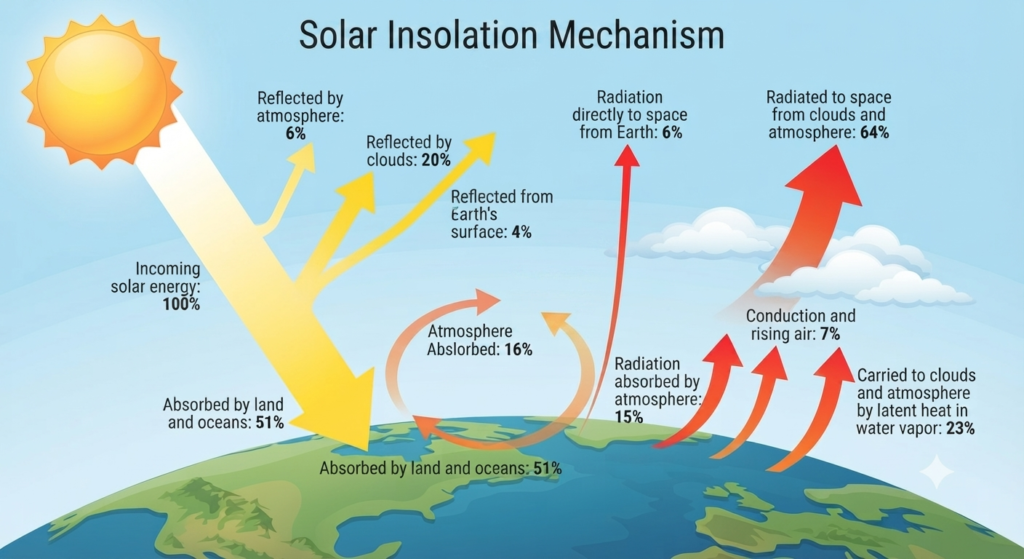
As sunlight passes through the atmosphere, some of the radiation is reflected, absorbed, and scattered by clouds, atmospheric gases, aerosols, and other particles. This reduces the amount of solar energy that ultimately reaches the surface.
Absorption by Earth’s Surface
The radiation that reaches the ground is absorbed by land, oceans, vegetation, and other surfaces. The absorbed solar energy is converted primarily into thermal energy, warming the Earth’s surface.
Transfer of Heat to the Atmosphere
A heated surface transfers energy to the atmosphere through processes such as conduction, convection, and infrared radiation. Warm air rises, creating convection currents that help redistribute heat within the atmosphere.
Atmospheric and Global Circulation
Unequal solar heating across different regions of Earth creates temperature and pressure differences. These differences drive winds, atmospheric circulation, oceanic processes, and weather systems, helping distribute heat from warmer regions toward cooler areas.
Earth’s Energy Balance
Earth continuously emits longwave infrared radiation back toward space. Over the long term, the climate system tends toward an energy balance in which the incoming solar energy is approximately balanced by the outgoing terrestrial radiation.
Simplified Solar Insolation Pathway:
Sun → Electromagnetic Radiation → Atmosphere → Absorption/Reflection/Scattering → Earth’s Surface → Heating → Atmospheric Circulation → Outgoing Terrestrial Radiation
Solar Insolation and Earth’s Heat Balance
Solar insolation is the primary energy input to the Earth’s climate system. However, Earth does not continuously accumulate all the solar energy it receives. A portion of incoming radiation is reflected or absorbed by the atmosphere and surface, while the Earth also continuously emits longwave terrestrial radiation back into space.
The long-term balance between incoming solar radiation and outgoing terrestrial radiation is known as the Earth’s energy balance or heat balance.
A simplified representation is:
Incoming Solar Radiation ≈ Outgoing Terrestrial Radiation
When incoming and outgoing energy are approximately balanced over the long term, Earth’s average temperature remains relatively stable. If the Earth system absorbs more energy than it releases, the climate system experiences net energy gain. Conversely, if outgoing energy exceeds incoming energy, the system experiences net energy loss.
However, this balance is not uniform across the planet. Tropical regions generally receive more solar energy than they lose through outgoing radiation, while polar regions experience the opposite tendency. Atmospheric circulation and ocean currents redistribute heat from energy-surplus regions toward energy-deficit regions.
Simplified Heat Balance Pathway:
Solar Insolation → Surface Heating → Terrestrial Radiation → Atmospheric Interaction → Heat Redistribution → Radiation to Space
Terrestrial Radiation
When Earth’s surface absorbs solar radiation, it becomes heated and subsequently emits energy in the form of longwave infrared radiation. This outgoing radiation is known as terrestrial radiation.
Unlike incoming solar radiation, which is dominated by shorter wavelengths, terrestrial radiation is primarily longwave infrared energy because Earth’s surface is much cooler than the Sun.
Some of this outgoing radiation is absorbed and re-emitted by atmospheric gases and clouds, while the remaining energy eventually escapes to space.
Therefore:
Solar Insolation → Shortwave Energy → Earth’s Surface → Heating → Longwave Terrestrial Radiation
This process is important because the Earth’s surface and atmosphere continuously exchange energy while the climate system ultimately loses energy to space.
Distribution of Solar Insolation
Solar Insolation is not distributed evenly across Earth. Its intensity varies with latitude, season, atmospheric conditions, cloud cover, surface characteristics, and the angle at which sunlight reaches the surface. These variations create differences in heating between the tropics, mid-latitudes, and polar regions and play an important role in global climate and atmospheric circulation.
Tropical Regions
Tropical regions generally receive high levels of solar radiation throughout the year because the Sun remains relatively high in the sky. Solar rays strike the surface at comparatively steep angles, concentrating energy over a smaller area. The relatively consistent day length also contributes to substantial annual solar input.
Polar Regions
Polar regions receive the least solar insolation. The Sun remains low above the horizon for much of the year, causing solar rays to strike the surface at a shallow angle and spread their energy over a larger area. During polar winter, some regions experience prolonged periods with little or no direct sunlight.
Subtropical Deserts
Subtropical desert regions can receive exceptionally high surface insolation. Their generally clear skies, low humidity, and limited cloud cover allow a large proportion of incoming solar radiation to reach the ground. This is why many major deserts are located around the subtropical high-pressure belts.
Continental and Oceanic Surfaces
At the same latitude, the amount of solar energy reaching land and ocean can differ because of variations in cloud cover, atmospheric moisture, and surface properties. Oceanic regions often experience greater evaporation and cloud formation, which can reflect or scatter incoming sunlight before it reaches the surface.
Mid-Latitude Regions
The mid-latitudes receive less solar radiation than the tropics but play a major role in global heat redistribution. Strong temperature contrasts between warm and cold air masses contribute to atmospheric circulation, frontal systems, and frequent weather disturbances. These processes transfer heat between different parts of the planet.
Equatorial Region
The equatorial region receives intense solar radiation because the Sun is generally high in the sky. However, strong evaporation, abundant moisture, and frequent cloud formation can reduce the amount of sunlight reaching the surface. Atmospheric and oceanic circulation then transport some of the accumulated heat toward higher latitudes.
Heating and Cooling of the Atmosphere
Solar insolation does not heat the atmosphere uniformly. Much of the incoming solar energy is absorbed by the Earth’s surface, which then transfers energy to the atmosphere through several processes.
Conduction
Conduction is the transfer of heat through direct contact. The Earth’s heated surface warms the air immediately above it, particularly in the lower atmosphere.
Convection
Convection involves the vertical movement of heated air. When air near the surface becomes warmer, it expands and becomes less dense, causing it to rise. Cooler, denser air then moves downward.
Surface Heating → Warm Air Rises → Cooler Air Descends → Convective Circulation
Convection is particularly important in the development of clouds, thunderstorms, and other atmospheric processes.
Advection
Advection refers to the horizontal transfer of heat by moving air. Winds can transport warm air from lower latitudes toward cooler regions and cold air toward warmer regions.
Together, these processes help redistribute heat within the atmosphere.
Solar Insolation vs. Terrestrial Radiation
| Feature | Solar Insolation | Terrestrial Radiation |
|---|---|---|
| Source | Sun | Earth’s surface and atmosphere |
| Direction | Mainly toward Earth | Mainly away from Earth |
| Radiation Type | Primarily shortwave | Primarily longwave infrared |
| Main Role | Provides incoming energy | Releases energy back toward space |
| Temperature of Source | Very high | Much lower than the Sun |
| Effect | Heats Earth’s surface and system | Helps Earth lose accumulated heat |
| Role in Energy Balance | Incoming energy | Outgoing energy |
Conclusion
Solar insolation is the foundation of Earth’s climate and energy system. The amount of solar radiation received at a location depends on factors such as latitude, Earth’s rotation and axial tilt, seasonal changes, day length, angle of incidence, and atmospheric transparency. These factors create significant differences in solar heating between tropical, temperate, and polar regions.
The absorbed solar energy warms the Earth’s surface, which subsequently releases terrestrial longwave radiation and transfers heat through conduction, convection, and advection. Although the distribution of energy varies geographically, the Earth maintains its long-term heat balance through the interaction of incoming solar radiation, outgoing terrestrial radiation, atmospheric circulation, and ocean currents.
Understanding solar insolation is therefore essential for explaining seasons, weather patterns, global atmospheric circulation, climate zones, heat distribution, and Earth’s overall energy balance. It also provides a fundamental basis for understanding solar energy availability and the role of the Sun in sustaining life on Earth.
Read Next: