Biomass energy is obtained from organic materials such as plants, wood, agricultural residues, food waste, animal manure, and other biological resources. Plants store solar energy through photosynthesis, and this stored chemical energy can later be released through combustion or converted into fuels, biogas, and other useful energy products.
Biomass is widely used for heating, industrial process energy, electricity generation, and the production of biofuels. However, although biomass is renewable, its environmental benefits depend strongly on how the feedstock is produced, collected, transported, processed, and used. In this article, we will discuss the 13 advantages and disadvantages of biomass energy in detail.
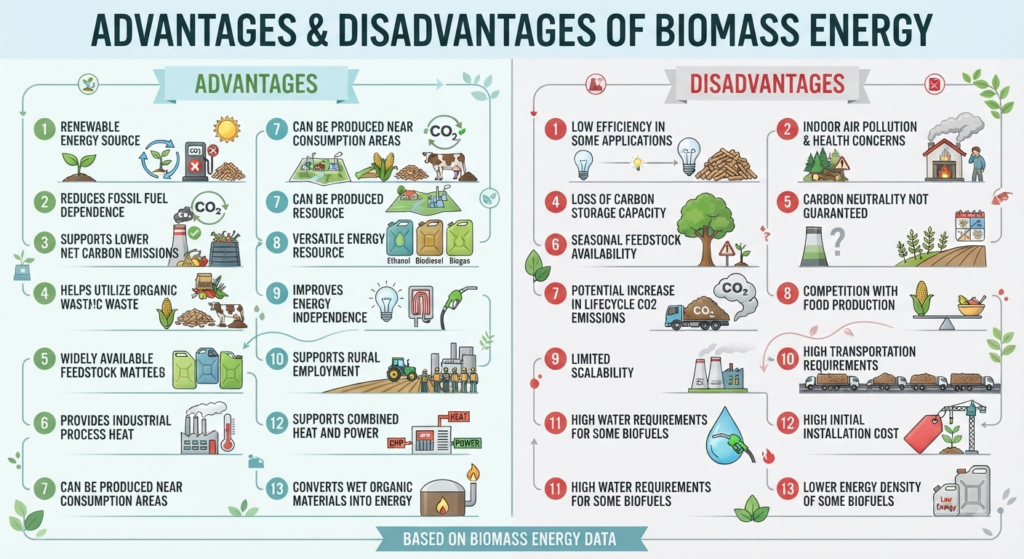
Summary Table: Advantages & Disadvantages of Biomass Energy
| Sr. No. | Advantages of Biomass Energy | Disadvantages of Biomass Energy |
|---|---|---|
| 1 | Renewable energy source | Low efficiency in some applications |
| 2 | Reduces fossil fuel dependence | Indoor air pollution and health concerns |
| 3 | Can support lower net carbon emissions | Deforestation risk |
| 4 | Helps utilize organic waste | Loss of carbon storage capacity |
| 5 | Widely available feedstock | Carbon neutrality is not guaranteed |
| 6 | Produces different types of biofuels | Seasonal feedstock availability |
| 7 | Can be produced near consumption areas | Potential increase in lifecycle CO₂ emissions |
| 8 | Versatile energy resource | Competition with food production |
| 9 | Improves energy independence | Limited scalability |
| 10 | Supports rural employment | High transportation requirements |
| 11 | Provides industrial process heat | High water requirements for some biofuels |
| 12 | Supports combined heat and power | High initial installation cost |
| 13 | Converts wet organic materials into energy | Lower energy density of some biofuels |
Advantages (Pros) of Biomass Energy
Biomass energy provides several benefits, including renewable fuel availability, waste utilization, energy diversification, and the production of different forms of useful energy.
1. Renewable Energy Source
Biomass is considered a renewable energy resource because it comes from organic materials that can be replenished through natural biological processes. Plants grow by using sunlight, water, and carbon dioxide through photosynthesis, storing chemical energy that can later be recovered for energy production.
2. Reduces Dependence on Fossil Fuels
Biomass can be converted into electricity, heat, and different types of fuel. Using these products can reduce dependence on finite fossil resources such as coal, petroleum, and natural gas.
3. Can Support Lower Net Carbon Emissions
Biomass can potentially provide a lower-carbon energy pathway when sustainably produced feedstocks are used. Plants absorb carbon dioxide during growth, while combustion releases carbon dioxide back into the atmosphere. However, this benefit depends on the complete lifecycle of the biomass resource and should not automatically be assumed for every biomass project.
4. Helps Utilize Organic Waste
Biomass energy provides a productive use for materials such as agricultural residues, food waste, yard waste, wood-processing waste, and animal manure. Instead of treating all these materials as waste, suitable fractions can be converted into heat, electricity, or fuels.
5. Widely Available Feedstock
Biomass resources can come from many sources, including crops, crop residues, forestry materials, wood-processing waste, food waste, animal manure, and other organic materials. This diversity can provide a broad feedstock base for different biomass technologies.
6. Produces Different Types of Biofuels
Biomass can be converted into fuels such as ethanol, biodiesel, methane-rich biogas, and other energy products. These fuels can be used for transportation, heating, electricity generation, or other applications depending on their characteristics and processing technology.
7. Can Be Produced Near Consumption Areas
Some biomass crops and residues can be sourced relatively close to processing or energy-generation facilities. Developing local supply chains can reduce the distance over which feedstocks need to be transported and can support decentralized energy systems.
8. Versatile Energy Resource
Biomass can be used in several ways. Solid biomass can provide direct heat, while other feedstocks can be converted into electricity, biogas, ethanol, biodiesel, pellets, and other fuels. This versatility allows biomass to serve different energy requirements.
9. Improves Energy Independence
Countries that have adequate agricultural, forestry, or organic waste resources can use locally produced biomass to diversify their energy supply. This can reduce the need to rely entirely on imported fossil fuels for certain energy applications.
10. Supports Rural Employment
Biomass supply chains require activities such as collection, processing, baling, pellet production, transportation, storage, and plant operation. These activities can create employment and business opportunities in agricultural and rural regions.
11. Provides Industrial Process Heat
Biomass can be directly combusted to produce heat for industrial applications. Wood residues, bagasse, rice husk, and other suitable fuels can be used in boilers to generate steam or process heat.
12. Supports Combined Heat and Power Generation
Biomass can be used in cogeneration systems to produce electricity and useful thermal energy from the same fuel. This can improve overall fuel utilization when there is a suitable demand for both electricity and heat.
13. Can Convert Wet Organic Materials Into Energy
Not all biomass needs to be burned. Wet organic materials such as manure and food waste can be processed through biological conversion technologies such as anaerobic digestion to produce biogas.
Disadvantages (Cons) of Biomass Energy
Despite its renewable nature, biomass energy has several limitations related to efficiency, air pollution, environmental impacts, seasonal fuel availability, land use, transportation, water consumption, cost, and energy density.
1. Low Efficiency in Some Biomass Applications
Biomass conversion efficiency depends heavily on the technology and operating conditions. Traditional biomass-burning systems can have relatively low efficiency because a significant portion of the energy in the fuel may be lost as heat and incomplete combustion products. Modern biomass boilers, pellet systems, gasifiers, and cogeneration plants can achieve much better performance.
2. Indoor Air Pollution and Health Concerns
Burning biomass in poorly ventilated indoor spaces can produce smoke and harmful combustion products. Traditional cooking and heating systems that use wood, crop residues, or other solid biomass can therefore create indoor air-quality problems when adequate ventilation and clean combustion technology are not available.
3. Deforestation Risk
Unsustainable harvesting of wood for biomass fuel can contribute to deforestation and forest degradation. If trees are removed faster than forests can naturally regenerate, biomass utilization can damage ecosystems rather than provide a sustainable energy source.
4. Loss of Carbon Storage Capacity
Forests, grasslands, and other vegetation store carbon and help remove carbon dioxide from the atmosphere. Excessive removal of vegetation for biomass can reduce this carbon-storage capacity. It can also contribute to biodiversity loss, soil degradation, and habitat destruction.
5. Carbon Neutrality Is Not Guaranteed
Biomass is sometimes considered carbon-neutral because plants absorb carbon dioxide during growth. However, the actual climate impact depends on the complete lifecycle, including cultivation, land-use change, harvesting, processing, transportation, and combustion.
Therefore, biomass should not automatically be considered carbon-neutral simply because it is renewable.
6. Seasonal Feedstock Availability
Many agricultural residues are available mainly during specific harvesting seasons. A biomass power plant operating throughout the year therefore needs adequate fuel storage and a reliable supply chain to maintain continuous operation.
Seasonal variations in crop production can also affect the quantity and price of available biomass.
7. Potential Increase in Lifecycle CO₂ Emissions
Biomass does not always result in lower overall greenhouse gas emissions. Cultivation, fertilizer use, land conversion, harvesting, drying, processing, and transportation can add emissions to the biomass lifecycle.
The actual climate benefit therefore depends on the type and source of biomass used.
8. Competition With Food Production
Dedicated energy crops can compete with food crops for agricultural land. If land is shifted from food production to energy-crop cultivation, it can create pressure on food availability, land prices, and agricultural resources.
Using agricultural residues and waste materials can help reduce this competition.
9. Limited Scalability of Some Biomass Systems
The amount of biomass that can be sustainably collected is limited. Increasing the capacity of a biomass power plant therefore requires a corresponding increase in reliable feedstock availability.
Large-scale projects may need extensive infrastructure for collection, transportation, preprocessing, storage, and fuel handling.
10. High Transportation Requirements
Biomass materials can be bulky and often have a lower energy density than fossil fuels. Large quantities may therefore need to be transported from farms, forests, or processing facilities to the energy plant.
Long transportation distances can increase fuel costs, operating expenses, and lifecycle emissions.
11. High Water Requirements for Some Biofuels
Certain biomass-based fuels can require substantial quantities of water during feedstock cultivation and processing. The water requirement varies considerably depending on the crop, climate, irrigation method, and conversion technology.
Therefore, water availability should be considered when planning large-scale biomass projects.
12. High Initial Installation Cost
Biomass energy systems can require significant initial investment. A biomass power plant may need boilers, combustion equipment, gasifiers, generators, fuel-handling systems, storage facilities, conveyors, pollution-control equipment, and other supporting infrastructure.
The overall project economics depend on plant size, technology, fuel availability, transportation distance, and local operating conditions.
13. Lower Energy Density of Some Biofuels
Some biomass-derived fuels have lower energy density than conventional fossil fuels. For example, ethanol contains less energy per unit volume than gasoline.
As a result, a greater quantity of some biofuels may be required to provide the same amount of useful energy, depending on the application.
14. Biomass Combustion Still Produces Pollutants
Biomass combustion does not completely eliminate air emissions. Depending on the fuel composition, combustion conditions, and equipment design, biomass systems can release particulate matter, nitrogen oxides, carbon monoxide, and other pollutants.
Proper combustion control, fuel preparation, boiler design, and emission-control equipment are therefore important for reducing these emissions.
Applications of Biomass Energy
Biomass energy can be used in residential, agricultural, commercial, and industrial applications. Organic materials such as wood, wood-processing waste, agricultural crops and residues, food waste, yard waste, animal manure, and sewage can serve as feedstocks.
Common applications include:
- Electricity generation using biomass boilers and steam turbines
- Industrial process heating using biomass-fired boilers
- Steam generation for manufacturing processes
- Bagasse cogeneration in sugar mills
- Biogas production from animal manure and organic waste
- Biomethane production from upgraded biogas
- Ethanol production from suitable agricultural feedstocks
- Biodiesel production from vegetable oils, fats, and other suitable feedstocks
- Pellet and briquette production from biomass residues
- Cooking and space heating using suitable biomass fuels
- Waste-to-energy systems using organic fractions of waste
Conclusion
Biomass energy offers an important way to convert organic materials and waste into useful heat, electricity, and fuels. Its major advantages include renewability, waste utilization, reduced dependence on fossil fuels, versatility, rural employment, energy independence, and industrial applications.
However, biomass energy also has significant disadvantages. Low efficiency in some applications, indoor air pollution, deforestation, seasonal availability, land competition, transportation requirements, water use, high installation costs, and lifecycle greenhouse gas emissions can reduce its environmental and economic benefits.
The key point is that biomass is renewable, but renewable does not automatically mean sustainable or carbon-neutral. The final environmental performance depends on the source of the biomass, land-use practices, harvesting methods, transportation distance, conversion efficiency, and emission controls.
Therefore, sustainably sourced agricultural residues, forestry residues, and organic wastes can often provide a more favorable pathway than biomass obtained through destructive land-use changes. Careful feedstock selection and efficient conversion technology are essential for obtaining the maximum benefit from biomass energy.
Read Next:
- Energy vs Power
- Energy Transformation: Meaning, Types & Examples
- Law of Energy Conservation: Definition, Formula, Explanation & Examples
- Wind Energy vs Solar Energy
- What Are Fossil Fuels? Types, Formation, Uses, and Environmental Effects
- Types of Biomass Energy: Forms, Conversion Methods and Uses
- Biomass Energy: Sources, Types, Conversion, Advantages, and Importance