Biomass energy is renewable energy produced from organic materials such as agricultural residues, wood, animal waste, food waste, and other biodegradable matter. It can be converted into heat, electricity, biogas, biomethane, ethanol, biodiesel, and other useful fuels.
Unlike fossil fuels, which release carbon that has been stored underground for millions of years, biomass uses carbon that is part of the relatively short biological carbon cycle. When biomass is produced and managed sustainably, it can help reduce dependence on coal, oil, and natural gas while also providing a useful way to manage organic waste.
In India, biomass energy has particular importance because of the country’s large agricultural sector and the availability of crop residues, bagasse, forestry residues, animal waste, and other organic resources. Biomass can also support rural employment, decentralized energy generation, and cleaner waste management.
What Is Biomass Energy?
Biomass energy is energy obtained from biological materials that come from plants, animals, and organic waste. Biomass may be used directly as a fuel or converted into another form of energy through thermal, chemical, or biological processes.
Common biomass materials include:
- Wood and wood chips
- Agricultural residues
- Rice husk
- Wheat straw
- Sugarcane bagasse
- Corn residues
- Sawdust
- Animal manure
- Food waste
- Sewage sludge
- Forestry residues
- Energy crops
- Organic municipal waste
The basic principle is simple:
Organic matter → Conversion process → Heat / Electricity / Fuel
For example, sugarcane bagasse can be burned in a boiler to produce steam. The steam can drive a turbine connected to a generator and produce electricity.
How Does Biomass Energy Work?
The method used to produce energy from biomass depends on the type and moisture content of the feedstock and the desired energy product.
A simplified biomass energy process is:
For electricity generation, the process may be:
For biogas production:
For liquid biofuel:
Vegetable Oil
Therefore, biomass is not a single technology. It is a broad category of renewable energy technologies.
Sources of Biomass Energy
Biomass energy can come from several agricultural, forestry, industrial, and municipal sources.
1. Agricultural Residues
Agriculture generates large quantities of organic residues that can be used as biomass fuel.
Examples include:
- Rice husk
- Rice straw
- Wheat straw
- Cotton stalks
- Corn stalks
- Groundnut shells
- Mustard residues
- Sugarcane bagasse
- Coconut shells
Agricultural residues are particularly important in countries with large agricultural sectors.
2. Forestry and Wood Waste
Wood-based biomass includes:
- Firewood
- Wood chips
- Bark
- Sawdust
- Forestry residues
- Wood pellets
- Wood-processing waste
Sawdust and wood chips can be processed into standardized fuels such as pellets.
3. Animal Waste
Animal manure can be converted into biogas through anaerobic digestion.
Cow dung is a commonly used feedstock for small-scale biogas plants in rural areas.
4. Municipal Organic Waste
Biodegradable components of municipal waste can provide biomass feedstock.
Examples include:
- Food waste
- Garden waste
- Paper
- Cardboard
- Wood waste
- Other biodegradable materials
5. Industrial Organic Waste
Several industries generate biomass residues.
Examples include:
- Sugar mills
- Rice mills
- Paper mills
- Food-processing plants
- Sawmills
- Distilleries
- Palm oil industries
Sugar mills, for example, can use bagasse as fuel for combined heat and power generation.
6. Energy Crops
Certain plants can be grown specifically for energy production.
Examples include:
- Miscanthus
- Switchgrass
- Short-rotation woody crops
- Certain oilseed crops
However, energy crops need careful land-use planning so that energy production does not compete excessively with food production.
Types of Biomass Energy
Biomass energy can be classified according to its physical form and the energy product produced.
| Type | Examples | Main Energy Product |
|---|---|---|
| Solid biomass | Wood, pellets, rice husk, bagasse | Heat and electricity |
| Biogas | Animal manure, food waste, sewage | Gas, heat and electricity |
| Biomethane | Upgraded biogas | Renewable gas |
| Bioethanol | Sugar and starch crops | Transport fuel |
| Biodiesel | Vegetable oils and used cooking oils | Diesel substitute |
| Bio-oil | Pyrolysis products | Liquid fuel/feedstock |
| Producer gas/syngas | Gasified biomass | Heat, power and fuel |
Biomass Energy Conversion Methods
There are several technologies for converting biomass into useful energy.
1. Direct Combustion
Direct combustion is one of the simplest biomass conversion methods.
Biomass is burned in a controlled combustion system to produce heat. The heat can be used directly or converted into electricity.
For a steam power plant:
Biomass → Combustion → Heat → Steam → Turbine → Generator → Electricity
Common fuels include:
- Wood chips
- Bagasse
- Rice husk
- Pellets
- Agricultural residues
The efficiency of the system depends on fuel quality, boiler design, steam conditions, turbine efficiency, and overall plant operation.
2. Gasification
Gasification converts biomass into a combustible gas by heating it at high temperatures with a controlled amount of oxygen, air, or steam.
The resulting gas, commonly called producer gas or syngas, contains gases such as:
- Carbon monoxide
- Hydrogen
- Methane
- Carbon dioxide
The gas can be burned in engines, boilers, or other energy conversion systems.
Biomass → Gasifier → Producer gas → Engine/boiler → Energy
Gasification is particularly useful when electricity or gaseous fuel is required from relatively dry biomass.
3. Pyrolysis
Pyrolysis involves heating biomass in the absence or near-absence of oxygen.
It can produce:
- Biochar
- Bio-oil
- Combustible gases
The distribution of products depends on temperature, heating rate, residence time, and feedstock characteristics.
Biochar can have applications in soil management and carbon storage, while bio-oil can be further processed for energy or industrial applications.
4. Anaerobic Digestion
Anaerobic digestion uses microorganisms to break down biodegradable organic material without oxygen.
The process produces biogas, which primarily contains methane and carbon dioxide.
Typical feedstocks include:
- Animal manure
- Food waste
- Sewage
- Agricultural residues
- Organic industrial waste
Biogas can be used for:
- Cooking
- Heating
- Electricity generation
- Combined heat and power
- Upgrading to biomethane
5. Fermentation
Fermentation is primarily used to produce bioethanol from carbohydrate-rich feedstocks.
The general process is:
Sugar/starch biomass → Fermentation → Ethanol → Fuel
Sugarcane and maize are examples of feedstocks used for ethanol production.
6. Transesterification
Vegetable oils and certain waste oils can be converted into biodiesel through transesterification.
The process converts triglycerides into fatty acid alkyl esters, commonly known as biodiesel.
Feedstocks may include:
- Vegetable oils
- Used cooking oil
- Animal fats
- Certain non-edible oils
Biomass Power Generation
Biomass can be used in thermal power plants to generate electricity.
A typical biomass power plant consists of:
- Biomass receiving system
- Fuel storage
- Fuel preparation system
- Conveyors
- Boiler
- Steam turbine
- Generator
- Condenser
- Cooling system
- Ash handling system
- Flue-gas cleaning equipment
The biomass is fed into a boiler where it is combusted. The heat converts water into high-pressure steam. The steam expands through a turbine, which drives an electrical generator.
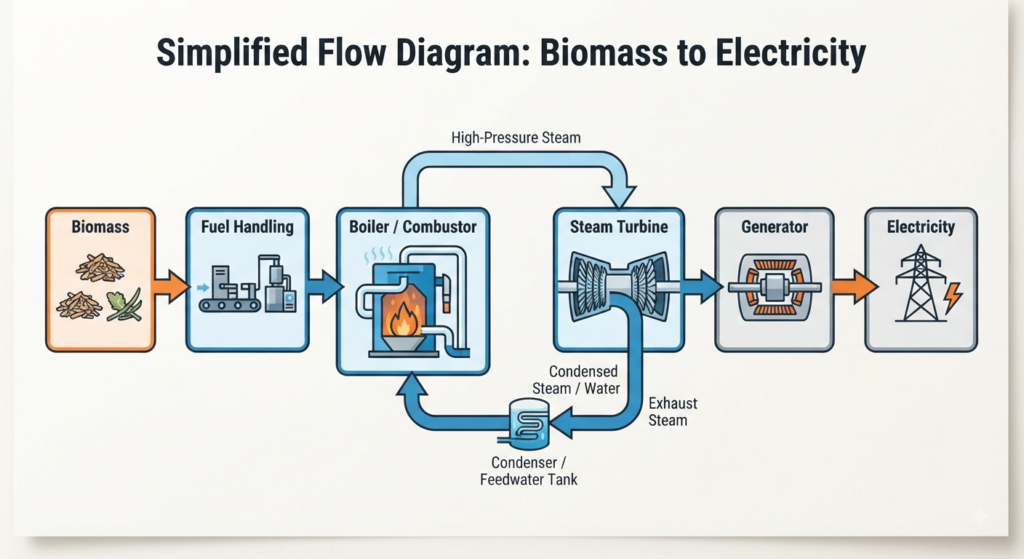
The ash generated during combustion may also be collected and used in suitable applications, depending on its chemical composition and applicable regulations.
Biomass Cogeneration
Biomass cogeneration, also called combined heat and power (CHP), produces electricity and useful heat from the same fuel.
Sugar mills are a well-known example.
Sugarcane is processed to produce sugar, leaving bagasse as a fibrous residue. The bagasse can be burned in boilers to produce steam.
Part of the steam can be used for:
- Process heating
- Sugar production
- Electricity generation
This allows the same biomass fuel to provide both process energy and electrical power.
Cogeneration can achieve much higher overall fuel utilization than producing electricity alone when the recovered heat has a useful application.
Biomass Energy in India
India has significant biomass energy potential because of its extensive agricultural activity and large quantities of agricultural residues.
Important Indian biomass resources include:
- Rice husk
- Wheat straw
- Sugarcane bagasse
- Cotton stalks
- Mustard residues
- Groundnut shells
- Coconut residues
- Forestry residues
- Animal waste
- Municipal organic waste
According to the Ministry of New and Renewable Energy (MNRE), India’s installed biomass power and cogeneration capacity is in the several-gigawatt range, although the exact figure changes as new projects are commissioned and older projects are retired or reclassified.
India also promotes biomass utilization in coal-based thermal power generation through biomass co-firing, particularly using biomass pellets.
Biomass Co-Firing in Thermal Power Plants
Biomass co-firing means using biomass along with coal in a thermal power plant.
For example:
The approach can help utilize agricultural residues and reduce a portion of coal consumption.
India’s National Mission on Use of Biomass in Coal Based Thermal Power Plants (SAMARTH) was established to promote biomass utilization in coal-fired power stations, address agricultural-residue burning, and develop the biomass pellet supply chain.
Biomass Energy Data and Key Facts
The following figures provide useful context, but values can vary by technology, feedstock, plant design, and year.
| Parameter | Typical/Indicative Value |
|---|---|
| Biomass moisture content | ~10–60% depending on feedstock |
| Typical biogas methane content | ~50–70% |
| Lower heating value of dry wood | ~15–20 MJ/kg |
| Biomass pellet moisture | Usually <10% |
| CHP overall energy utilization | Can exceed 70% when heat is effectively utilized |
| Biomass ash content | Highly variable, often ~1–20% depending on feedstock |
| Biomass power plant electrical efficiency | Commonly around 20–35% for many steam-cycle plants |
| Typical biogas energy content | Roughly 5–7 kWh/m³ depending on methane concentration |
Note: These are indicative engineering ranges rather than universal specifications. Actual values should be obtained from the particular biomass fuel analysis and plant design.
Advantages of Biomass Energy
Biomass energy offers several environmental, economic, and energy-security benefits. Its major advantages include:
- Renewable Energy Source: Biomass can be replenished through agriculture, forestry, and other biological processes when resources are managed sustainably.
- Waste Utilization: It converts agricultural residues, animal waste, food waste, and other organic materials into useful energy instead of allowing them to be discarded or burned openly.
- Reduces Fossil Fuel Dependence: Biomass can partially replace coal, diesel, natural gas, and other fossil fuels for electricity generation, heating, and transportation.
- Supports Rural Employment: Biomass collection, transportation, processing, pellet production, and power generation can create employment opportunities, particularly in rural areas.
- Improves Energy Security: Locally available biomass can reduce dependence on imported fossil fuels and support decentralized energy generation.
- Versatile Energy Source: Biomass can be converted into electricity, steam, process heat, biogas, biomethane, ethanol, biodiesel, pellets, and other fuels.
- Supports Farmers: Agricultural residues can provide an additional source of income for farmers when they are collected and sold as biomass fuel.
- Reduces Open Burning: Using crop residues for energy can provide an alternative to open-field burning, helping reduce associated air pollution when sustainable collection systems are available.
Disadvantages and Concerns of Biomass Energy
Although biomass energy is renewable, it is not automatically carbon-neutral or environmentally harmless. Its overall sustainability depends on how biomass is produced, collected, transported, processed, and used. The major disadvantages and concerns include:
- Air Pollution: Burning biomass can produce particulate matter, carbon monoxide, nitrogen oxides, and other pollutants. Efficient combustion and suitable emission-control systems are therefore important.
- Land Competition: Growing dedicated energy crops may compete with food production and agricultural land if not properly planned.
- Deforestation Risk: Unsustainable harvesting of wood and forest residues can contribute to deforestation, habitat loss, and biodiversity damage.
- High Moisture Content: Some biomass fuels contain significant moisture, which lowers their heating value and increases drying, handling, and transportation requirements.
- Seasonal Availability: Agricultural residues are often available only during particular harvesting periods. Adequate storage and reliable supply chains are therefore necessary for continuous power generation.
- Transportation Costs: Biomass generally has lower energy density than fossil fuels. Transporting large quantities over long distances can increase both operating costs and emissions.
- Ash, Fouling, and Corrosion: Biomass containing high levels of ash, silica, potassium, or chlorine can cause slagging, fouling, corrosion, and increased boiler maintenance, particularly in plants designed mainly for coal.
- Lifecycle Carbon Emissions: Biomass can produce emissions during cultivation, harvesting, drying, processing, transportation, and combustion. Therefore, its actual climate benefit depends on the complete lifecycle and sustainability of the biomass supply chain.
Biomass Energy vs Fossil Fuels
| Feature | Biomass Energy | Fossil Fuels |
|---|---|---|
| Source | Organic biological material | Coal, oil and natural gas |
| Renewability | Renewable when sustainably managed | Non-renewable |
| Carbon cycle | Part of short biological cycle | Adds geologically stored carbon |
| Waste utilization | Can use organic waste | Generally does not utilize organic waste |
| Energy density | Generally lower | Generally higher |
| Fuel supply | Often locally available | Often requires mining or extraction |
| Air emissions | Depends on technology and fuel | Generally significant |
| Storage | Can require substantial space | Usually easier to store per unit of energy |
| Applications | Heat, power and biofuels | Heat, power and fuels |
| Sustainability | Depends on feedstock management | Limited by finite reserves and emissions |
Importance of Biomass Energy
The importance of biomass energy goes beyond electricity generation. It can contribute to energy security, waste management, rural development, industrial energy supply, and climate goals.
- Energy Security: Locally available biomass can diversify the energy mix and reduce dependence on conventional fossil fuels.
- Waste Management: Biomass technologies can convert agricultural residues, animal waste, food waste, and other organic materials into useful energy.
- Rural Development: Biomass collection, processing, transportation, and power projects can create employment and additional income opportunities in rural areas.
- Decentralized Energy: Small biomass and biogas systems can generate energy close to where organic resources are available, reducing the need for long-distance energy transmission.
- Industrial Energy: Industries such as sugar mills, rice mills, food-processing plants, and paper mills can use their biomass residues to produce process heat, steam, and electricity.
- Climate Goals: Sustainably sourced biomass, particularly agricultural and organic waste, can help reduce fossil-fuel consumption and support the transition toward a lower-carbon energy system.
Government Initiatives for Biomass Energy in India
The Government of India has introduced several policies and programs to promote biomass energy, biofuels, waste-to-energy projects, and the efficient use of agricultural residues.
- National Bioenergy Programme: The Ministry of New and Renewable Energy (MNRE) supports bioenergy development through programs covering biomass power and cogeneration, biogas, and waste-to-energy technologies.
- SAMARTH Mission: The National Mission on Use of Biomass in Coal Based Thermal Power Plants (SAMARTH) promotes the use of biomass pellets in coal-based power plants. It focuses on biomass co-firing, development of reliable pellet supply chains, and addressing technical challenges associated with biomass utilization.
- National Policy on Biofuels: India’s biofuel policy promotes fuels such as ethanol and biodiesel to reduce dependence on petroleum-based fuels and encourage the use of domestic renewable resources.
- Waste-to-Energy Programs: Organic municipal, agricultural, industrial, and other biodegradable waste can be converted into useful energy through technologies such as anaerobic digestion, biomethanation, combustion, and other waste-to-energy processes.
- Biomass Co-Firing: The government has encouraged thermal power plants to use biomass pellets along with coal, providing an additional use for agricultural residues and supporting efforts to reduce open-field crop-residue burning.
Note: Biomass policies, targets, subsidies, and financial incentives can change over time. Therefore, current MNRE, Ministry of Power, and other official government notifications should be consulted before quoting specific targets or incentive amounts.
Factors Affecting Biomass Power Plant Efficiency
The efficiency and overall performance of a biomass power plant depend on fuel characteristics, boiler technology, operating conditions, and the reliability of the biomass supply chain. The major factors include:
- Fuel Quality: Biomass with high moisture content generally has a lower useful heating value and requires more energy for combustion. Consistent fuel quality also helps maintain stable boiler operation.
- Calorific Value: Biomass with a higher calorific value can produce more heat and electricity per unit of fuel, improving overall plant performance.
- Ash Content: High ash content increases ash-handling requirements and can cause problems such as fouling, slagging, and reduced heat-transfer efficiency.
- Combustion Technology: The choice of grate-fired, fluidized-bed, or other combustion technology affects fuel flexibility, combustion efficiency, emissions, and maintenance requirements.
- Steam Parameters: Optimized steam pressure and temperature can improve the efficiency of the steam cycle, provided the boiler and turbine are designed to operate safely at those conditions.
- Plant Load Factor: Reliable fuel availability allows the plant to operate for more hours at an efficient load, improving capacity utilization and reducing the impact of fixed operating costs.
- Supply Chain: Efficient biomass collection, transportation, storage, drying, and preprocessing are essential for maintaining a reliable fuel supply and controlling operating costs.
Applications of Biomass Energy
Biomass energy is used in many sectors.
| Sector | Application |
|---|---|
| Agriculture | Crop-residue energy and biogas |
| Sugar industry | Bagasse cogeneration |
| Rice mills | Rice-husk boilers and gasifiers |
| Food industry | Process heat |
| Dairy farms | Biogas production |
| Municipal sector | Organic waste-to-energy |
| Transport | Ethanol and biodiesel |
| Power sector | Biomass-fired electricity |
| Residential sector | Biogas and biomass heating |
| Industry | Steam and process heat |
Future of Biomass Energy
The future of biomass energy will depend increasingly on efficient technologies, sustainable feedstock management, and improved supply chains.
Several areas have strong potential:
- Advanced biomass gasification
- Biomethane production
- Second-generation biofuels
- Agricultural-residue pellets
- Biomass co-firing
- Waste-to-energy systems
- Biomass-based CHP
- Biochar production
- Sustainable aviation fuels
- Integration of biomass with carbon-capture technologies
A major opportunity is the conversion of agricultural residues into standardized pellets and other fuels. This can make a variable agricultural resource easier to transport, store, and use in industrial boilers and power plants.
Conclusion
Biomass energy is an important renewable energy resource that can convert agricultural residues, forestry waste, animal manure, food waste, and other organic materials into useful heat, electricity, biogas, biomethane, and biofuels.
Its major strengths are renewable resource availability, waste utilization, rural economic opportunities, energy diversification, and the potential to reduce fossil-fuel consumption. However, biomass must be managed carefully because issues such as air pollution, land competition, transportation emissions, deforestation, ash-related problems, and unsustainable harvesting can reduce its environmental benefits.
For India, biomass has particular significance because of the country’s large agricultural and industrial residue base. Technologies such as biomass power generation, bagasse cogeneration, anaerobic digestion, biomass gasification, pellet production, and biomass co-firing can help turn organic residues into valuable energy resources.
Ultimately, the success of biomass energy depends not simply on using biomass, but on using the right feedstock, efficient conversion technology, sustainable supply chains, and appropriate emission controls.
Frequently Asked Questions
Biomass energy is renewable energy obtained from organic materials such as wood, agricultural residues, animal manure, food waste, and other biological matter.
Yes, biomass can be renewable when the biological resources are replenished at a sustainable rate and their harvesting does not cause long-term environmental damage.
The major sources include agricultural residues, forestry waste, wood, animal manure, food waste, municipal organic waste, industrial organic residues, and energy crops.
Biomass can be burned in a boiler to produce steam. The steam drives a turbine connected to a generator, producing electricity. Gasification and biogas-based generation are other routes.
Biomass cogeneration produces electricity and useful heat simultaneously from biomass fuel. It is widely applicable in industries with both electrical and thermal energy requirements.
Read Next: