Electric batteries have become an essential part of modern life. An electric battery is a device that stores chemical energy and converts it into electrical energy through electrochemical reactions. They power everything from smartphones and laptops to electric vehicles, solar energy storage systems, medical devices, and industrial equipment. As the demand for portable electronics and renewable energy continues to grow, batteries have become one of the most important energy storage technologies in the world.
When connected to an electrical circuit, the battery produces a flow of electrons that powers electrical and electronic devices. Unlike generators that produce electricity continuously, batteries store energy and release it whenever required.
Today, batteries are available in many shapes, sizes, voltages, and chemistries. Some are designed for one-time use, while others can be recharged hundreds or even thousands of times. Selecting the right battery depends on factors such as voltage, capacity, application, operating temperature, lifespan, and cost.
This comprehensive guide explains what an electric battery is, how it works, its construction, types, specifications, characteristics, applications, and future technologies. Throughout the article, you’ll also find links to detailed guides on individual battery topics for a deeper understanding.
Key Takeaways
- An electric battery converts chemical energy into electrical energy through electrochemical reactions.
- A battery consists of one or more electrochemical cells connected together.
- Every battery contains four essential components: an anode, a cathode, an electrolyte, and a separator.
- Batteries are classified into primary (non-rechargeable) and secondary (rechargeable) batteries.
- Common rechargeable batteries include lead-acid, lithium-ion, nickel-metal hydride (NiMH), and lithium iron phosphate (LiFePO₄).
- Battery performance depends on voltage, capacity, internal resistance, temperature, charging method, and discharge rate.
- Electric batteries are widely used in consumer electronics, automobiles, renewable energy systems, UPS systems, industrial equipment, and electric vehicles.
What Is an Electric Battery?
An electric battery is an electrochemical device that stores energy in the form of chemical energy and converts it into electrical energy when connected to an external circuit. It provides a direct current (DC) power source that can operate electrical and electronic devices without requiring a continuous external power supply.
A battery consists of one or more electrochemical cells connected in series, parallel, or a combination of both to achieve the required voltage and capacity. Each cell contains two electrodes immersed in an electrolyte, where chemical reactions produce a flow of electrons through the external circuit.
When the battery is connected to a load, oxidation occurs at the negative electrode (anode), releasing electrons. These electrons travel through the external circuit to the positive electrode (cathode), where reduction takes place. At the same time, ions move through the electrolyte to maintain electrical neutrality. This movement of electrons and ions creates an electric current that powers the connected device.
Unlike generators, which produce electricity from mechanical energy, batteries store energy in advance and release it on demand. This ability makes batteries ideal for portable devices, backup power systems, and renewable energy storage applications.
Why Are Electric Batteries Important?
Electric batteries have transformed the way electricity is stored and used. Their portability, reliability, and ability to supply instant power make them indispensable in residential, commercial, industrial, and transportation sectors.
Some key reasons why batteries are important include:
- They provide portable power for electronic devices such as smartphones, laptops, cameras, and wearable technology.
- They serve as backup power sources in uninterruptible power supply (UPS) systems, hospitals, and data centers.
- Batteries store electricity generated from renewable sources like solar panels and wind turbines for use when generation is low.
- They are the primary energy source for electric vehicles (EVs), reducing dependence on fossil fuels.
- Many industrial control systems, emergency lighting, communication networks, and medical equipment rely on batteries for uninterrupted operation.
Advancements in battery technology are also accelerating the global transition toward clean energy, smart grids, and sustainable transportation.
History of the Electric Battery
The development of the electric battery has played a significant role in the advancement of electrical engineering and modern technology. Over the past two centuries, battery technology has evolved from simple experimental cells to highly efficient energy storage systems capable of powering electric vehicles and supporting large-scale renewable energy projects.
Early Discoveries
In the eighteenth century, scientists began experimenting with static electricity and chemical reactions to understand how electricity could be generated and stored. These experiments laid the foundation for the invention of the first practical battery.
Alessandro Volta and the First Battery
The first true electric battery was invented in 1800 by Italian physicist Alessandro Volta. His invention, known as the Voltaic Pile, consisted of alternating zinc and copper discs separated by cloth soaked in saltwater or acid.
The Voltaic Pile produced a continuous electric current, unlike previous electrostatic devices, and marked the beginning of modern electrochemistry. The unit of electric potential, the volt (V), is named in his honor.
Daniell Cell
In 1836, British chemist John Frederic Daniell introduced the Daniell Cell, which offered a more stable voltage and longer operating life than the Voltaic Pile. It became widely used in telegraph systems and scientific research.
Dry Cell Batteries
The invention of the dry cell battery in the late nineteenth century replaced liquid electrolytes with paste electrolytes, making batteries safer, more portable, and suitable for consumer products such as flashlights and radios.
Rechargeable Batteries
The development of rechargeable batteries, particularly lead-acid batteries, revolutionized automotive and industrial applications. Over time, newer chemistries such as nickel-cadmium (NiCd), nickel-metal hydride (NiMH), and lithium-ion significantly improved battery performance, lifespan, and energy density.
Modern Battery Technology
Today, lithium-ion batteries dominate the market because of their high energy density, lightweight design, and long cycle life. Researchers are also developing next-generation technologies such as solid-state batteries, sodium-ion batteries, and lithium-sulfur batteries to improve safety, charging speed, and sustainability.
Difference Between a Cell and a Battery
The terms cell and battery are often used interchangeably, but they have different meanings.
| Feature | Cell | Battery |
|---|---|---|
| Definition | A single electrochemical unit that converts chemical energy into electrical energy | A combination of one or more cells connected together |
| Number of Cells | One | One or multiple |
| Voltage | Lower | Can be increased by connecting cells in series |
| Capacity | Limited | Higher than a single cell |
| Examples | AA cell, AAA cell, coin cell | Car battery, laptop battery, UPS battery |
For example, an AA alkaline battery commonly contains a single electrochemical cell, while a 12 V automotive battery consists of six lead-acid cells connected in series.
Understanding this distinction is important because battery voltage, capacity, and performance depend on how individual cells are connected.
Construction of an Electric Battery
Although batteries vary in chemistry and design, most electric batteries are built using the same fundamental components. These components work together to store and release electrical energy efficiently.
A typical battery consists of:
- Anode – the negative electrode where oxidation occurs during discharge.
- Cathode – the positive electrode where reduction takes place.
- Electrolyte – a medium that allows ions to move between the electrodes.
- Separator – a porous insulating layer that prevents direct contact between the electrodes while allowing ion flow.
- Current Collectors – conductive materials that transfer electrons between the electrodes and the external circuit.
- Battery Enclosure – protects internal components from moisture, mechanical damage, and contamination.
- Battery Terminals – provide electrical connections to the external circuit.
In the next section, we will examine each of these components in detail and understand how they work together during charging and discharging.
Although batteries differ in size, chemistry, and application, they all share a similar basic construction. Every electric battery is made up of components that work together to store chemical energy and convert it into electrical energy. The design of these components directly affects the battery’s voltage, capacity, efficiency, charging speed, and lifespan.
The main components of an electric battery are the anode, cathode, electrolyte, separator, current collectors, battery casing, and terminals. Each component performs a specific function during the charging and discharging process.
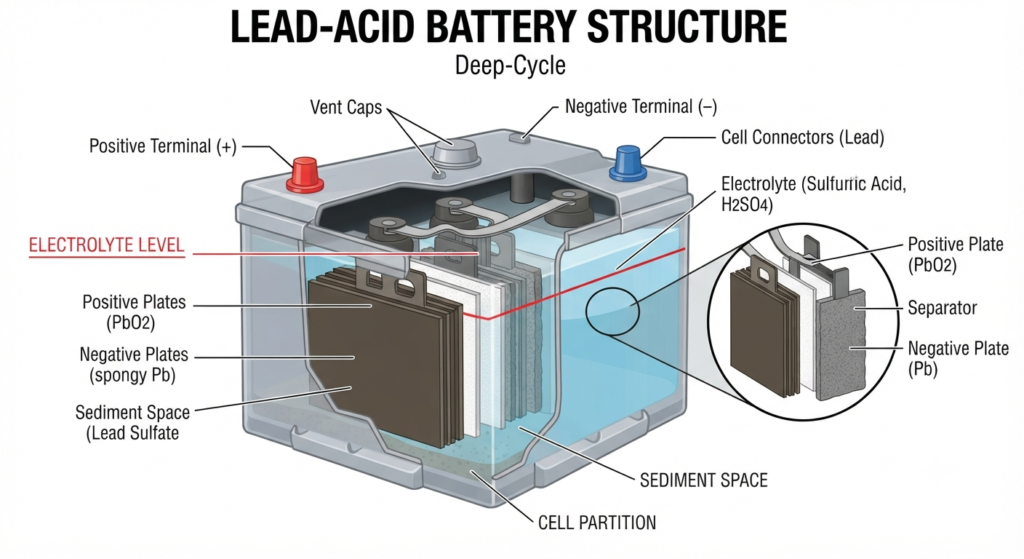
Main Components of an Electric Battery
1. Anode
The anode is the negative electrode during battery discharge. It is the source of electrons that flow through the external circuit to power electrical devices.
During discharge, oxidation takes place at the anode. In this reaction, the anode material loses electrons and releases positively charged ions into the electrolyte.
The material used for the anode depends on the battery chemistry. For example:
- Zinc in zinc-carbon and alkaline batteries
- Lead in lead-acid batteries
- Graphite in lithium-ion batteries
- Lithium metal in some primary lithium batteries
The anode material should have high electrical conductivity, good chemical stability, and the ability to release electrons efficiently.
2. Cathode
The cathode is the positive electrode during battery discharge. It accepts electrons returning from the external circuit.
At the cathode, reduction occurs. Positive ions arriving through the electrolyte combine with electrons from the external circuit, completing the electrochemical reaction.
Common cathode materials include:
- Manganese dioxide
- Lead dioxide
- Lithium cobalt oxide
- Lithium iron phosphate (LiFePO₄)
- Nickel oxide
The cathode largely determines the battery’s voltage, energy density, and operating characteristics.
3. Electrolyte
The electrolyte is the medium that transports ions between the anode and cathode while preventing direct electron flow inside the battery.
Instead of carrying electrons, the electrolyte carries charged ions that maintain electrical balance during battery operation.
Electrolytes may be:
- Liquid
- Gel
- Paste
- Solid
Examples include:
| Battery Type | Electrolyte |
|---|---|
| Lead-Acid | Dilute sulfuric acid |
| Alkaline | Potassium hydroxide |
| Lithium-Ion | Organic lithium salt solution |
| Solid-State Battery | Solid ceramic or polymer electrolyte |
A good electrolyte should have high ionic conductivity, chemical stability, and a wide operating temperature range.
4. Separator
The separator is a thin porous insulating material placed between the anode and cathode.
Its main functions are to:
- Prevent direct contact between the electrodes
- Avoid internal short circuits
- Allow ions to pass through freely
- Improve battery safety
Although the separator blocks electrons, it allows ions to move between the electrodes through microscopic pores.
Modern lithium-ion batteries use advanced polymer separators with excellent thermal stability.
5. Current Collectors
Current collectors are highly conductive metal sheets that transfer electrons between the electrodes and the battery terminals.
Typical materials include:
- Copper foil for the anode
- Aluminum foil for the cathode
They reduce electrical resistance and improve battery efficiency.
6. Battery Enclosure (Casing)
The battery enclosure protects all internal components from:
- Moisture
- Dust
- Mechanical damage
- Chemical leakage
- Corrosion
Battery cases are commonly made of:
- Steel
- Aluminum
- Plastic
- Stainless steel
For electric vehicle batteries, lightweight aluminum alloy enclosures are widely used to reduce overall vehicle weight.
7. Battery Terminals
Battery terminals provide the electrical connection between the battery and the external circuit.
Every battery has:
- Positive (+) terminal
- Negative (–) terminal
The terminals must provide low contact resistance and withstand repeated connections without corrosion.
How Does an Electric Battery Work?
An electric battery works by converting stored chemical energy into electrical energy through electrochemical (redox) reactions. These reactions occur automatically when the battery is connected to an external circuit.
During discharge:
- Oxidation occurs at the anode.
- Electrons are released from the anode.
- These electrons travel through the external circuit and power the connected load.
- At the same time, ions move through the electrolyte toward the cathode.
- Reduction occurs at the cathode, where electrons combine with ions.
- The circuit is completed, allowing continuous current flow until the battery is discharged.
For rechargeable batteries, applying an external charging voltage reverses these reactions, restoring the original chemical composition of the electrodes.
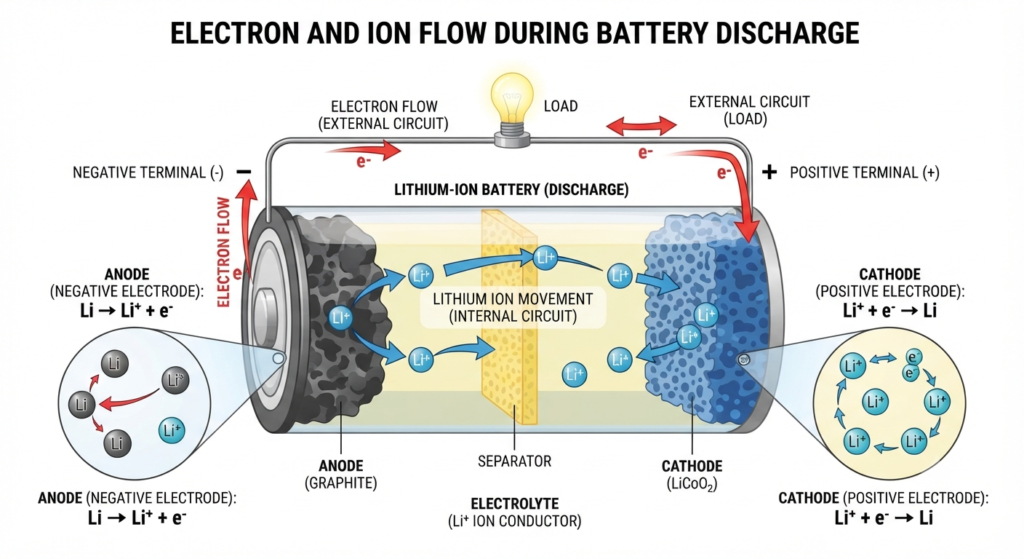
Electrochemical Reactions in a Battery
The operation of a battery is based on oxidation-reduction (redox) reactions.
Oxidation
Oxidation is the process in which the anode loses electrons.
For example:
Zn → Zn²⁺ + 2e⁻
The released electrons travel through the external circuit and provide electrical power.
Reduction
Reduction occurs at the cathode, where positive ions gain electrons.
For example:
Cu²⁺ + 2e⁻ → Cu
This reaction completes the electrical circuit and enables continuous current flow.
Electron Flow
Electrons always move:
- From the negative terminal to the positive terminal
- Through the external electrical circuit
This movement of electrons is the electric current used by electrical devices.
Ion Movement
Inside the battery:
- Positive ions (cations) move toward the cathode.
- Negative ions (anions), where applicable, move toward the anode.
This ion movement balances the charge and allows the electrochemical reactions to continue.
Charging and Discharging Process
The charging and discharging process determines how a battery stores and releases energy.
During Discharging
- Chemical energy converts into electrical energy.
- The battery supplies power to the connected load.
- Electrode materials gradually change due to electrochemical reactions.
During Charging
- Electrical energy converts back into chemical energy.
- An external charger forces current into the battery.
- The original chemical composition of the electrodes is restored.
Only secondary (rechargeable) batteries can undergo repeated charging and discharging cycles.
Classification of Electric Batteries
Electric batteries can be classified in several ways depending on their rechargeability, electrolyte, chemistry, construction, and application.
Based on Rechargeability
This is the most common classification.
Primary Batteries
Primary batteries are non-rechargeable batteries designed for one-time use. Once the stored chemical energy is exhausted, they cannot be recharged economically or safely.
Examples include:
- Zinc-carbon batteries
- Alkaline batteries
- Lithium primary batteries
- Silver oxide batteries
- Zinc-air batteries
Primary batteries are commonly used in remote controls, flashlights, clocks, smoke detectors, and calculators.
Secondary Batteries
Secondary batteries are rechargeable batteries. Their chemical reactions can be reversed by applying an external charging current, allowing them to be used repeatedly.
Common rechargeable batteries include:
- Lead-acid batteries
- Lithium-ion batteries
- Nickel-cadmium batteries
- Nickel-metal hydride batteries
- Lithium iron phosphate (LiFePO₄) batteries
They are widely used in electric vehicles, UPS systems, solar energy storage, laptops, smartphones, and industrial equipment.
Based on Electrolyte
Batteries can also be classified according to the type of electrolyte they use:
- Wet Cell Batteries
- Dry Cell Batteries
- Gel Cell Batteries
- Absorbent Glass Mat (AGM) Batteries
- Solid-State Batteries
Each type offers different advantages in terms of maintenance, safety, energy density, and performance.
Based on Battery Chemistry
Modern batteries use different chemical combinations to achieve specific performance characteristics.
Common battery chemistries include:
- Zinc-Carbon
- Alkaline
- Lead-Acid
- Nickel-Cadmium (NiCd)
- Nickel-Metal Hydride (NiMH)
- Lithium-Ion (Li-ion)
- Lithium Polymer (Li-Po)
- Lithium Iron Phosphate (LiFePO₄)
- Sodium-Ion
- Zinc-Air
- Silver Oxide
Each chemistry has unique advantages, limitations, charging methods, and applications.
Types of Electric Batteries
Electric batteries are available in a wide range of designs and chemical compositions to meet different power requirements. Some batteries are designed for single use, while others can be recharged hundreds or even thousands of times. Choosing the right battery depends on factors such as voltage, capacity, lifespan, charging speed, operating temperature, and application.
The two main categories of electric batteries are primary batteries and secondary batteries.
Primary Batteries (Non-Rechargeable)
Primary batteries are designed for one-time use. Once the stored chemical energy is exhausted, they cannot be recharged safely or economically. They are widely used in low-power devices because they have a long shelf life and require no maintenance.
Some common primary batteries include:
- Zinc-Carbon Battery – Used in clocks, flashlights, and remote controls.
- Alkaline Battery – Offers higher capacity and longer life than zinc-carbon batteries.
- Lithium Primary Battery – Provides high energy density and excellent shelf life.
- Silver Oxide Battery – Commonly used in watches and medical instruments.
- Zinc-Air Battery – Widely used in hearing aids due to its high energy density.
Advantages
- Ready to use
- Long storage life
- Low maintenance
- Economical for low-drain applications
Limitations
- Cannot be recharged
- Higher long-term operating cost
- Generates more waste
Secondary Batteries (Rechargeable)
Secondary batteries can be recharged multiple times by applying an external electrical source. Their reversible chemical reactions make them suitable for applications requiring frequent charging and discharging.
Popular rechargeable batteries include:
Lead-Acid Battery
Lead-acid batteries are among the oldest rechargeable batteries. They are widely used in automobiles, UPS systems, emergency lighting, and solar power installations because they are reliable and inexpensive.
Lithium-Ion Battery
Lithium-ion batteries are the most widely used rechargeable batteries today. They offer high energy density, lightweight construction, fast charging, and long cycle life. They are commonly found in smartphones, laptops, electric vehicles, and portable electronics.
Lithium Iron Phosphate (LiFePO₄) Battery
LiFePO₄ batteries are known for their excellent safety, thermal stability, and long service life. They are increasingly used in solar energy systems, electric vehicles, and industrial energy storage.
Nickel-Cadmium (NiCd) Battery
NiCd batteries provide high discharge current and reliable performance under harsh operating conditions. They are commonly used in aviation, emergency systems, and industrial equipment.
Nickel-Metal Hydride (NiMH) Battery
NiMH batteries offer higher capacity than NiCd batteries while being more environmentally friendly. They are widely used in rechargeable household electronics and hybrid vehicles.
Advantages
- Rechargeable
- Lower long-term cost
- Environmentally friendly compared to disposable batteries
- Suitable for high-power applications
Limitations
- Higher initial cost
- Require proper charging methods
- Performance gradually decreases with age
Suggested Internal Links
- Lead-Acid Battery
- Lithium-Ion Battery
- LiFePO₄ Battery
- Nickel-Cadmium Battery
- Nickel-Metal Hydride Battery
Primary Battery vs Secondary Battery
| Feature | Primary Battery | Secondary Battery |
|---|---|---|
| Rechargeable | No | Yes |
| Initial Cost | Low | Higher |
| Long-Term Cost | Higher | Lower |
| Cycle Life | Single use | Hundreds to thousands of cycles |
| Maintenance | Minimal | Requires proper charging |
| Common Applications | Clocks, remotes, flashlights | EVs, UPS, laptops, solar systems |
Battery Specifications
Battery specifications describe the electrical and performance characteristics of a battery. Understanding these parameters helps engineers and users select the most suitable battery for a particular application.
Battery Voltage
Battery voltage is the electrical potential difference between the positive and negative terminals. It determines how much electrical pressure is available to drive current through a circuit.
Examples include:
- AA Alkaline Battery – 1.5 V
- Lead-Acid Cell – 2 V
- Lithium-Ion Cell – 3.6–3.7 V
Multiple cells can be connected in series to increase the overall voltage.
Battery Capacity (Ah)
Battery capacity indicates the amount of electrical charge a battery can deliver over a specified period. It is measured in ampere-hours (Ah) or milliampere-hours (mAh).
For example, a 100 Ah battery can theoretically supply:
- 10 A for 10 hours
- 20 A for 5 hours
- 5 A for 20 hours
Actual capacity varies depending on temperature, discharge rate, and battery condition.
Battery Energy (Wh)
Battery energy represents the total energy stored in a battery and is expressed in watt-hours (Wh).
The relationship is:
E=V×Ah
For example, a 12 V, 100 Ah battery stores approximately 1200 Wh (1.2 kWh) of energy.
Battery Power
Power indicates how quickly a battery can deliver energy and is measured in watts (W).
P=V×I
High-power batteries are commonly used in electric vehicles, power tools, and industrial machinery.
Energy Density
Energy density refers to the amount of energy stored per unit mass or volume.
A higher energy density means:
- Longer operating time
- Smaller battery size
- Reduced weight
Lithium-ion batteries have a much higher energy density than lead-acid batteries.
Power Density
Power density indicates how quickly a battery can deliver energy.
Applications requiring rapid bursts of power, such as electric vehicles and power tools, need batteries with high power density.
Internal Resistance
Every battery has some internal resistance that opposes current flow.
High internal resistance results in:
- Reduced efficiency
- Greater heat generation
- Lower output voltage under load
Lower internal resistance improves battery performance and charging efficiency.
C-Rate
The C-rate indicates how fast a battery is charged or discharged relative to its rated capacity.
- 1C means the battery charges or discharges in one hour.
- 0.5C means two hours.
- 2C means approximately 30 minutes.
Higher C-rates increase heating and may reduce battery lifespan.
Cycle Life
Cycle life is the number of complete charge-discharge cycles a battery can undergo before its capacity falls to a specified level, typically 80% of the original capacity.
Modern lithium-ion batteries often provide 1,000–3,000 cycles, while LiFePO₄ batteries can exceed 5,000 cycles under suitable operating conditions.
Shelf Life
Shelf life refers to the period a battery can be stored before its performance begins to decline significantly.
Primary lithium batteries generally have longer shelf lives than rechargeable batteries.
Self-Discharge
Even when not connected to a load, batteries gradually lose stored charge over time due to internal chemical reactions. This phenomenon is known as self-discharge.
Lithium-ion batteries have relatively low self-discharge, whereas nickel-based batteries lose charge more quickly.
Battery Characteristics
Battery characteristics describe how a battery behaves under different operating conditions. These characteristics help evaluate battery performance, efficiency, and suitability for specific applications.
The important battery characteristics include:
- Voltage Characteristics
- Capacity Characteristics
- Charging Characteristics
- Discharging Characteristics
- Temperature Characteristics
- Efficiency Characteristics
Each of these topics is broad enough to be covered in a dedicated article.
Battery Charging Characteristics
Charging restores the chemical energy stored in a rechargeable battery. Different battery chemistries require different charging methods to ensure safety, efficiency, and long service life.
Common charging methods include:
- Constant Current (CC)
- Constant Voltage (CV)
- Constant Current–Constant Voltage (CC-CV)
- Trickle Charging
- Float Charging
- Fast Charging
Proper charging prevents overcharging, overheating, and premature battery degradation.
Suggested Internal Links
- Battery Charging Methods
- Battery Charger
- CC-CV Charging
- Trickle Charging
Battery Discharging Characteristics
During discharge, the battery converts chemical energy into electrical energy to power a connected load.
Important discharge parameters include:
- Discharge current
- Terminal voltage
- Cut-off voltage
- Capacity utilization
- Depth of discharge (DoD)
- C-rate
Excessive deep discharge can reduce battery lifespan, particularly in lead-acid batteries.
Battery Connections
Individual batteries are often connected together to achieve the required voltage or capacity.
Batteries in Series
Connecting batteries in series increases the total output voltage while keeping the capacity (Ah) the same.
Example:
- Four 12 V batteries in series produce 48 V.
Batteries in Parallel
Connecting batteries in parallel increases the total capacity while maintaining the same voltage.
Example:
- Two 12 V, 100 Ah batteries connected in parallel produce 12 V, 200 Ah.
Series-Parallel Connection
A combination of series and parallel connections is commonly used in:
- Electric vehicles
- Solar battery banks
- UPS systems
- Industrial energy storage
This configuration provides both higher voltage and greater capacity.
Applications of Electric Batteries
Electric batteries have become indispensable across residential, commercial, industrial, and transportation sectors. Their ability to store electrical energy and deliver power whenever required makes them suitable for countless applications, from small electronic gadgets to large-scale energy storage systems.
Consumer Electronics
Rechargeable batteries power many everyday devices, including:
- Smartphones
- Laptops
- Tablets
- Digital cameras
- Smartwatches
- Wireless headphones
- Portable gaming consoles
Lithium-ion batteries are the preferred choice for these devices because of their high energy density, lightweight design, and long cycle life.
Automotive Industry
Conventional vehicles use lead-acid batteries for starting, lighting, and ignition (SLI). In contrast, electric vehicles (EVs) primarily rely on lithium-ion battery packs due to their high energy density, fast charging capability, and long service life.
Renewable Energy Systems
Solar and wind energy systems use battery banks to store excess electricity generated during peak production. The stored energy can then be used during cloudy weather, nighttime, or periods of high electricity demand.
Common batteries used in renewable energy systems include:
- Lead-acid batteries
- Lithium-ion batteries
- LiFePO₄ batteries
Uninterruptible Power Supply (UPS)
UPS systems provide emergency backup power during utility power failures. Batteries ensure uninterrupted operation of:
- Computers
- Data centers
- Hospitals
- Telecommunication equipment
- Banking systems
Industrial Applications
Industries use batteries for:
- Forklifts
- Material handling equipment
- Emergency lighting
- Control systems
- Industrial automation
- Backup power systems
Medical Equipment
Reliable battery power is essential for life-saving medical devices such as:
- Defibrillators
- Infusion pumps
- Portable ventilators
- Patient monitoring systems
- Wheelchairs
Aerospace and Defense
Aircraft, satellites, spacecraft, and military equipment require lightweight, high-performance batteries capable of operating under extreme environmental conditions.
Advantages of Electric Batteries
Electric batteries offer several benefits that make them one of the most widely used energy storage solutions.
- Portable and compact power source
- Instant electricity without startup delay
- Quiet operation with no moving parts
- High efficiency compared to many conventional energy storage systems
- Available in various voltages, capacities, and sizes
- Rechargeable batteries reduce long-term operating costs
- Suitable for renewable energy storage
- Low maintenance for many battery types
- Easy integration with electronic devices and control systems
These advantages have made batteries a key component in the transition toward clean energy and electrified transportation.
Disadvantages of Electric Batteries
Despite their many benefits, batteries also have certain limitations.
- Limited energy storage compared to fossil fuels
- Capacity decreases with age and repeated charging
- Performance is affected by temperature
- Charging requires time
- Some batteries contain hazardous materials
- Improper charging can reduce battery life
- High-capacity batteries can be expensive
- Disposal and recycling require proper environmental management
Selecting the appropriate battery chemistry helps minimize these limitations for specific applications.
Battery Maintenance Tips
Proper maintenance improves battery performance, increases service life, and reduces the risk of unexpected failures.
Some recommended maintenance practices include:
- Keep battery terminals clean and free from corrosion.
- Avoid deep discharging unless the battery is specifically designed for it.
- Use a charger recommended by the manufacturer.
- Do not overcharge or overheat the battery.
- Store batteries in a cool, dry place away from direct sunlight.
- Inspect batteries regularly for swelling, cracks, or leakage.
- Maintain the recommended electrolyte level in flooded lead-acid batteries.
- Disconnect batteries from devices that will not be used for long periods.
Following these simple practices can significantly extend battery life.
Battery Safety Precautions
Although modern batteries are designed with numerous safety features, improper handling can lead to overheating, leakage, fire, or explosion.
Follow these important safety precautions:
- Never short-circuit battery terminals.
- Use only compatible chargers.
- Do not expose batteries to excessive heat or open flames.
- Avoid puncturing, crushing, or dropping batteries.
- Replace damaged or swollen batteries immediately.
- Keep batteries away from children and pets.
- Wear appropriate protective equipment when handling large industrial batteries.
- Follow manufacturer guidelines for charging and storage.
Lithium-ion batteries require special attention because damaged cells may experience thermal runaway, a condition that can lead to fire.
Battery Recycling and Environmental Impact
Many batteries contain valuable metals such as lithium, cobalt, nickel, and lead, which can be recovered through recycling. Proper recycling reduces environmental pollution, conserves natural resources, and minimizes landfill waste.
Some benefits of battery recycling include:
- Recovery of valuable raw materials
- Reduced mining of natural resources
- Lower environmental pollution
- Conservation of energy used in material extraction
- Safe disposal of hazardous substances
Users should never dispose of batteries with regular household waste. Instead, they should use authorized battery collection or recycling centers.
Emerging Battery Technologies
Researchers continue to develop advanced battery technologies that offer higher energy density, improved safety, faster charging, and longer service life.
Some promising technologies include:
Solid-State Batteries
Solid-state batteries replace liquid electrolytes with solid electrolytes, offering improved safety, faster charging, and higher energy density.
Sodium-Ion Batteries
Sodium-ion batteries use abundant sodium instead of lithium, making them a cost-effective alternative for large-scale energy storage.
Lithium-Sulfur Batteries
Lithium-sulfur batteries have the potential to deliver significantly higher energy density than conventional lithium-ion batteries while reducing material costs.
Silicon-Anode Batteries
Replacing graphite with silicon in the anode can substantially increase battery capacity and improve charging performance.
Graphene Batteries
Graphene-based batteries are being developed to provide faster charging, higher conductivity, and improved durability.
These technologies are expected to play an important role in the future of electric vehicles, renewable energy storage, and portable electronics.
Conclusion
Electric batteries have transformed the way electrical energy is stored and used, making modern portable electronics, electric vehicles, renewable energy systems, and backup power solutions possible. By converting chemical energy into electrical energy, batteries provide a reliable and efficient source of direct current for a wide range of applications.
Understanding battery construction, working principles, types, specifications, and performance characteristics helps users select the right battery for their needs and use it safely and efficiently. As technology continues to evolve, innovations such as solid-state, sodium-ion, and lithium-sulfur batteries are expected to deliver safer, longer-lasting, and more sustainable energy storage solutions.
Whether you are an engineering student, technician, or industry professional, learning the fundamentals of electric batteries provides a strong foundation for understanding modern electrical systems. For more in-depth information, explore our detailed guides on battery types, charging methods, battery specifications, maintenance, safety, and emerging battery technologies.
Read Next: