The Sun shines because of nuclear fusion, a process in which lightweight hydrogen nuclei combine to form helium while releasing an enormous amount of energy. Every ray of sunlight and every bit of heat reaching Earth originates from this fusion reaction occurring deep inside the Sun’s core.
Unlike burning coal or wood, the Sun does not produce energy through chemical combustion. Instead, it generates energy through nuclear fusion, which converts a small amount of mass directly into energy according to Einstein’s famous equation:
This continuous fusion process has powered the Sun for approximately 4.6 billion years and is expected to continue for another 5 billion years.
What Is Nuclear Fusion?
Nuclear fusion is a nuclear reaction in which two or more light atomic nuclei combine to form a heavier nucleus, releasing a tremendous amount of energy.
In the Sun, the fuel is hydrogen, and the final product is helium. During this process, a tiny portion of the hydrogen’s mass is converted into energy.
Unlike nuclear fission, which splits heavy atoms such as uranium, nuclear fusion joins lighter atoms together.
Where Does Nuclear Fusion Occur in the Sun?
Nuclear fusion occurs almost entirely in the core of the Sun, where extreme conditions make the reaction possible.
| Property | Approximate Value |
|---|---|
| Core Temperature | 15 million °C |
| Core Pressure | About 250 billion atmospheres |
| Core Density | About 150 g/cm³ |
| Primary Fuel | Hydrogen (Protons) |
The enormous gravitational pressure inside the Sun forces hydrogen nuclei close enough for the strong nuclear force to overcome their natural electrical repulsion.
What Is the Proton-Proton Chain Reaction?
The primary fusion reaction in the Sun is known as the proton-proton (pp) chain.
It is the dominant energy-producing process in stars that are similar in size to the Sun.
Overall Nuclear Reaction
Where:
- ¹H = Hydrogen nucleus (proton)
- ⁴He = Helium nucleus
- e⁺ = Positron
- ν = Neutrino
The released energy eventually reaches Earth as sunlight and heat.
Steps of Nuclear Fusion in the Sun
The proton-proton chain occurs through a series of nuclear reactions.
Step 1: Two Protons Fuse
Two hydrogen nuclei (protons) collide under extremely high temperature and pressure in the Sun’s core. Most collisions are unsuccessful because the positively charged protons repel each other. However, in rare cases, one proton transforms into a neutron through the weak nuclear force. This allows the two particles to combine and form a deuterium nucleus (hydrogen-2).
During this reaction, a positron (e⁺) and an electron neutrino (νₑ) are also emitted.
Products formed:
- One deuterium nucleus (²H)
- One positron (e⁺)
- One electron neutrino (νₑ)
Nuclear Equation
This is the slowest step and determines the Sun’s long lifetime.
Step 2: Formation of Helium-3
The newly formed deuterium nucleus (²H) collides with another hydrogen nucleus (proton) in the Sun’s core. The two nuclei fuse to form a helium-3 nucleus (³He) while releasing a high-energy gamma-ray photon (γ).
The emitted gamma ray carries a portion of the fusion energy and begins its long journey from the Sun’s core toward the surface, where it is eventually transformed into visible sunlight.
Products formed:
- One helium-3 nucleus (³He)
- One gamma-ray photon (γ)
Nuclear Equation
The gamma rays produced begin a long journey toward the Sun’s surface.
Step 3: Formation of Helium-4
The newly formed deuterium nucleus (²H) collides with another hydrogen nucleus (proton) in the Sun’s core. Under the extreme temperature and pressure, the two nuclei fuse to form a helium-3 nucleus (³He) while releasing a high-energy gamma-ray photon (γ).
The emitted gamma ray carries part of the fusion energy and begins its long journey through the Sun’s interior. After passing through the Sun’s layers over thousands to hundreds of thousands of years, this energy eventually reaches the photosphere and is emitted into space as sunlight.
Products formed:
- One helium-3 nucleus (³He)
- One gamma-ray photon (γ)
Nuclear Equation
The released protons can participate in future fusion reactions.
Overall Reaction
Combining all three steps gives:
The helium nucleus has slightly less mass than the four original hydrogen nuclei.
This missing mass is converted into energy.
Why Does Fusion Release Energy?
Nuclear fusion releases energy because the helium nucleus produced has slightly less mass than the four hydrogen nuclei that originally fused together. This difference in mass, known as the mass defect, is converted directly into energy according to Einstein’s mass-energy equivalence equation:
where:
- E = Energy
- m = Mass
- c = Speed of light
Since the speed of light squared (c²) is an extremely large number, even a very small amount of mass is converted into an enormous amount of energy. This energy is released primarily as gamma rays, kinetic energy of particles, and neutrinos, which ultimately heat the Sun and produce the light that reaches Earth.
During the proton-proton chain reaction, only about 0.7% of the original hydrogen mass is converted into energy, while the remaining 99.3% becomes part of the helium nucleus. Although this mass loss is tiny, the Sun converts approximately 4.26 million metric tonnes of matter into energy every second, producing about 3.8 × 10²⁶ watts of power. This continuous energy release has kept the Sun shining for billions of years.
How Much Energy Does the Sun Produce?
The Sun performs an astonishing number of fusion reactions every second.
| Parameter | Value |
|---|---|
| Fusion Reactions per Second | Approximately 9.2 × 1037 |
| Mass Converted into Energy Each Second | About 4.26 million metric tonnes |
| Solar Power Output | Approximately 3.8 × 1026 watts |
This immense energy is radiated throughout the solar system.
How Does Energy Reach Earth?
The energy produced in the Sun’s core does not escape immediately.
Instead, it passes through several layers:
- Core
- Radiative Zone
- Convective Zone
- Photosphere (Visible Surface)
- Space
A single photon may take thousands to hundreds of thousands of years to reach the Sun’s surface because it is repeatedly absorbed and re-emitted inside the Sun.
Once it reaches the photosphere, sunlight takes only about 8 minutes and 20 seconds to travel to Earth.
Why Doesn’t the Sun Explode?
Although billions of fusion reactions occur every second, the Sun remains stable because two forces balance each other.
| Outward Force | Inward Force |
|---|---|
| Pressure produced by nuclear fusion | Gravity pulling inward |
This balance is known as hydrostatic equilibrium.
If fusion increases, the Sun expands slightly, reducing the reaction rate. If fusion slows, gravity compresses the core, increasing the reaction rate again.
Why Is Nuclear Fusion Important?
Nuclear fusion is essential because it:
- Produces all the Sun’s heat and light
- Provides energy for life on Earth
- Drives Earth’s climate and weather
- Powers photosynthesis in plants
- Creates helium from hydrogen
- Serves as the energy source for most stars in the universe
Without fusion, the Sun would quickly cool, and life on Earth would not exist.
Nuclear Fusion vs Nuclear Fission
The table below highlights the key differences between nuclear fusion and nuclear fission.
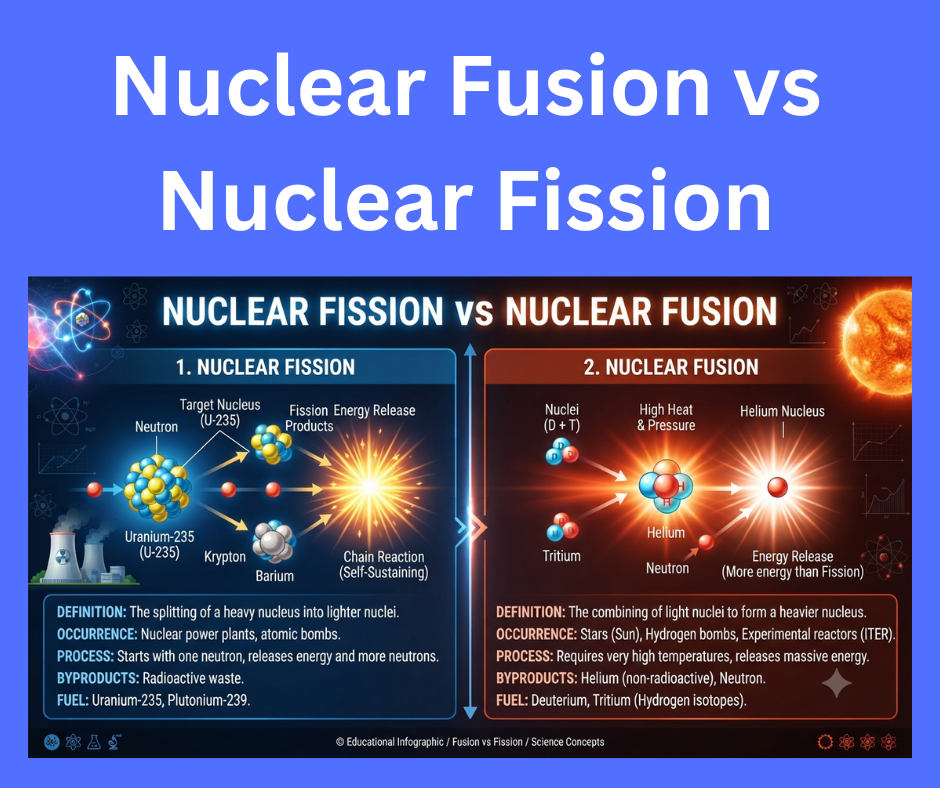
| Feature | Nuclear Fusion | Nuclear Fission |
|---|---|---|
| Process | Combines light nuclei | Splits heavy nuclei |
| Fuel | Hydrogen isotopes | Uranium or Plutonium |
| Product | Helium | Smaller nuclei |
| Energy Release | Very high | High |
| Radioactive Waste | Very little | Significant |
| Occurs Naturally | Stars | Rarely |
Interesting Facts About Nuclear Fusion in the Sun
- The Sun converts about 600 million tonnes of hydrogen into helium every second.
- Around 4.26 million tonnes of mass are transformed directly into energy every second.
- The Sun has been generating energy through fusion for about 4.6 billion years.
- Scientists are working to replicate controlled nuclear fusion on Earth as a future source of clean energy.
- Neutrinos produced during fusion pass through Earth almost without interacting with matter.
Conclusion
Nuclear fusion is the fundamental process that powers the Sun and sustains life on Earth. Through the proton-proton chain reaction, hydrogen nuclei combine to form helium, releasing vast amounts of energy in the form of heat, light, gamma rays, and neutrinos. Although only about 0.7% of the reacting mass is converted into energy, this small mass loss generates approximately 3.8 × 10²⁶ watts of power every second. This remarkable process has kept the Sun shining for billions of years and will continue to do so for billions more, making nuclear fusion one of the most important natural phenomena in the univ
Frequently Asked Questions (FAQs)
The Sun primarily generates energy through the proton-proton (pp) chain reaction, where hydrogen nuclei fuse to form helium.
The Sun is hot because nuclear fusion in its core continuously releases enormous amounts of energy.
Hydrogen nuclei (protons) are the primary fuel used in the Sun’s fusion reactions.
The Sun emits approximately 3.8 × 10²⁶ joules of energy per second (equivalent to 3.8 × 10²⁶ watts).
A small portion of the original mass is converted into energy according to Einstein’s E = mc².
Read Next: