A phase change is one of the most fundamental processes in physics and chemistry. It explains how matter transforms between different physical states when environmental conditions such as temperature or pressure change.
From ice melting into water to steam condensing into liquid, phase changes occur continuously in nature and are widely used in refrigeration, power generation, manufacturing, and many other industrial applications. Understanding phase change helps explain the behavior of materials under different conditions and the role of energy in changing the state of matter.
What Is Phase Change?
A phase change is the transformation of a substance from one state of matter to another, such as solid, liquid, gas, or plasma, without altering its chemical composition. During this process, the substance absorbs or releases energy, changing the arrangement and movement of its particles rather than its chemical identity. Depending on the amount of heat transferred and the surrounding pressure, a material may undergo melting, freezing, vaporization, condensation, sublimation, or deposition.
Unlike a chemical reaction, a phase change does not produce a new substance. For example, when ice melts into water or water evaporates into steam, the substance remains H₂O even though its physical state changes.
Why Does Phase Change Occur?
A phase change occurs because the energy of a substance changes. When heat is added, particles gain kinetic energy, move more freely, and may transition to a less ordered state, such as from a solid to a liquid or from a liquid to a gas. Conversely, when heat is removed, particles lose energy, move closer together, and transition to a more ordered state.
Pressure also influences phase changes. Increasing or decreasing pressure can shift the temperatures at which melting, boiling, or condensation occurs. This is why water boils at a lower temperature in high-altitude regions, where atmospheric pressure is lower than at sea level.
The temperature at which a phase change occurs is different for every substance. This is because molecules in different materials are held together by intermolecular forces of varying strength. Substances with stronger intermolecular forces require more energy to separate their particles, resulting in higher melting and boiling points. Conversely, substances with weaker intermolecular forces undergo phase changes at lower temperatures.
Phase Change Diagram
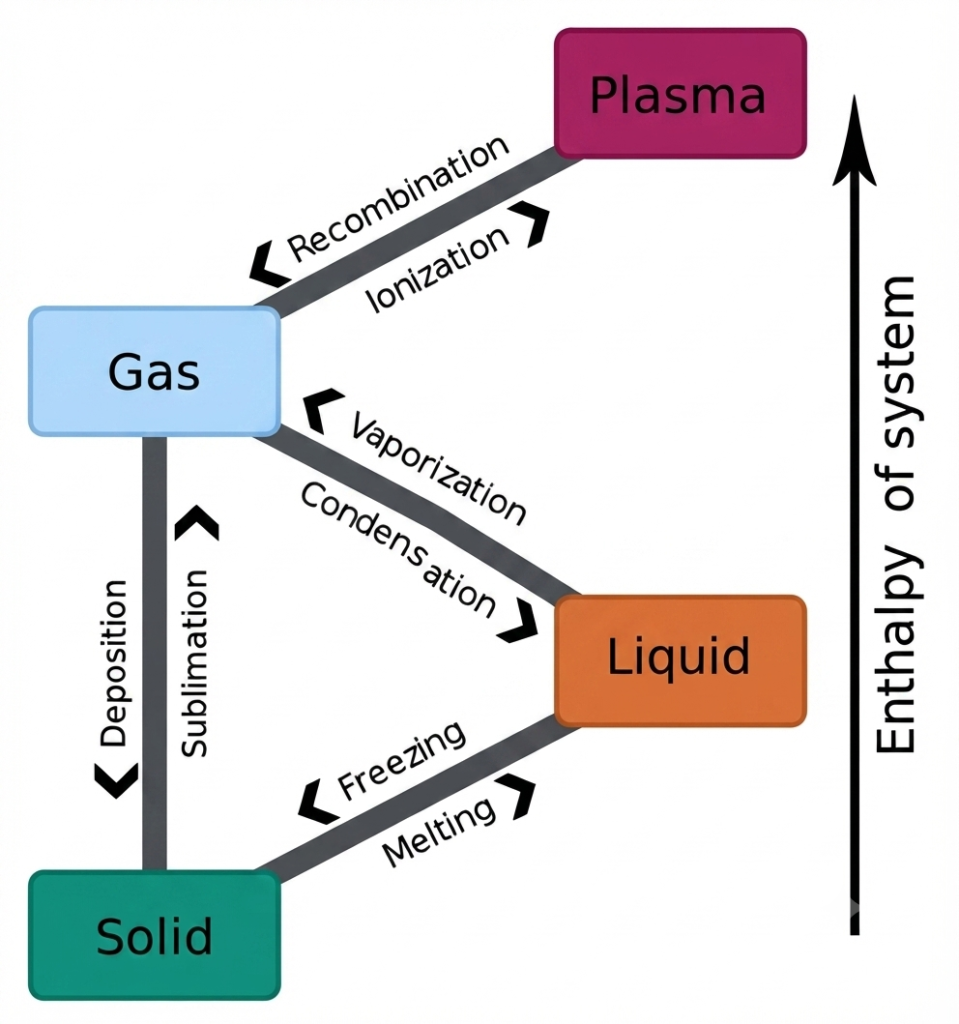
A phase change diagram illustrates the possible transitions between the four common states of matter: solid, liquid, gas, and plasma. Each transition occurs when a substance absorbs or releases energy. Processes such as melting, vaporization, and sublimation require heat to be absorbed, whereas freezing, condensation, and deposition occur when heat is released.
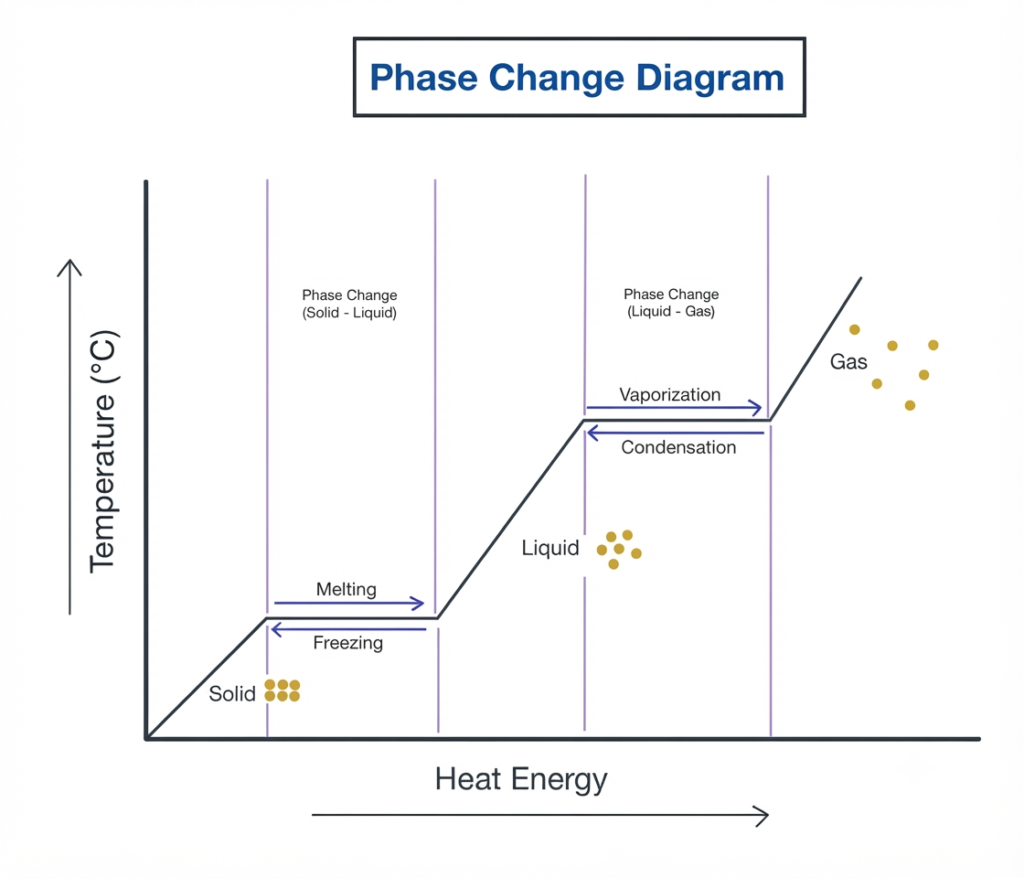
The diagram provides a quick overview of how matter changes from one state to another under different temperature and pressure conditions.
Types of Phase Change
Matter can undergo six major phase changes, depending on whether it gains or loses thermal energy. The table below summarizes each type of phase transition, the states involved, and whether heat is absorbed or released.
| Phase Change | Initial State | Final State | Heat Transfer | Common Example |
|---|---|---|---|---|
| Melting | Solid | Liquid | Absorbed | Ice → Water |
| Freezing | Liquid | Solid | Released | Water → Ice |
| Vaporization | Liquid | Gas | Absorbed | Water → Steam |
| Condensation | Gas | Liquid | Released | Steam → Water |
| Sublimation | Solid | Gas | Absorbed | Dry Ice → CO₂ Gas |
| Deposition | Gas | Solid | Released | Water Vapor → Frost |
1. Melting
Melting is the process in which a solid absorbs heat and changes into a liquid. As thermal energy increases, the particles vibrate more rapidly until they overcome the forces holding them in fixed positions. The substance then begins to flow as a liquid.
Example: Ice melting into water is the most common example of melting.
2. Freezing
Freezing is the reverse of melting. When a liquid loses heat, its particles slow down and arrange themselves into a fixed structure, forming a solid.
Example: Water turning into ice inside a freezer.
3. Vaporization
Vaporization is the conversion of a liquid into a gas. It occurs in two forms:
- Boiling: Takes place throughout the liquid when it reaches its boiling point.
- Evaporation: Occurs only at the liquid surface and can happen at temperatures below the boiling point.
Example: Water changing into steam during boiling.
4. Condensation
Condensation occurs when a gas loses heat and transforms into a liquid. As the particles lose energy, they move closer together and form liquid droplets.
Example: Water droplets forming on the outside of a chilled bottle or glass.
5. Sublimation
Sublimation is a phase change in which a solid changes directly into a gas without first becoming a liquid. This process usually occurs under low-pressure conditions or in substances with specific physical properties.
Examples: Dry ice (solid carbon dioxide), iodine crystals, and naphthalene balls.
6. Deposition
Deposition is the direct conversion of a gas into a solid without passing through the liquid phase. It is the opposite of sublimation and occurs when a gas loses sufficient energy.
Examples: Frost forming on cold surfaces and snow crystals developing from water vapor in the atmosphere.
Endothermic vs. Exothermic Phase Changes
Phase changes are classified based on whether heat is absorbed or released.
| Endothermic Phase Changes | Exothermic Phase Changes |
|---|---|
| Melting | Freezing |
| Vaporization | Condensation |
| Sublimation | Deposition |
| Heat is absorbed | Heat is released |
| Particle energy increases | Particle energy decreases |
Latent Heat of Phase Change
During a phase change, a substance absorbs or releases energy without any change in its temperature. This energy is known as latent heat. Instead of raising or lowering the temperature, the energy is used to break or form the intermolecular forces that hold the particles together.
There are two main types of latent heat:
| Type | Description | Example |
|---|---|---|
| Latent Heat of Fusion | Energy required to convert a solid into a liquid or a liquid into a solid without changing temperature. | Ice melting into water |
| Latent Heat of Vaporization | Energy required to convert a liquid into a gas or a gas into a liquid at constant temperature. | Water boiling into steam |
The amount of latent heat depends on the type of substance and the phase transition taking place. Materials with a high latent heat can absorb or release large amounts of energy, making them useful in cooling systems, thermal energy storage, and power generation.
Latent Heat Formula for Phase Change
The amount of heat required for a phase change can be calculated using the latent heat equation.
Where:
- Q = Heat energy transferred (J)
- m = Mass of the substance (kg)
- L = Specific latent heat (J/kg)
Example: Calculate the heat required to melt 2 kg of ice. The latent heat of fusion of ice is 334 kJ/kg.
Solution
Therefore, 668 kJ of heat is required to completely melt 2 kg of ice.
Note: Use the latent heat of fusion for melting and freezing, and the latent heat of vaporization for boiling and condensation.
Heating Curve of Water
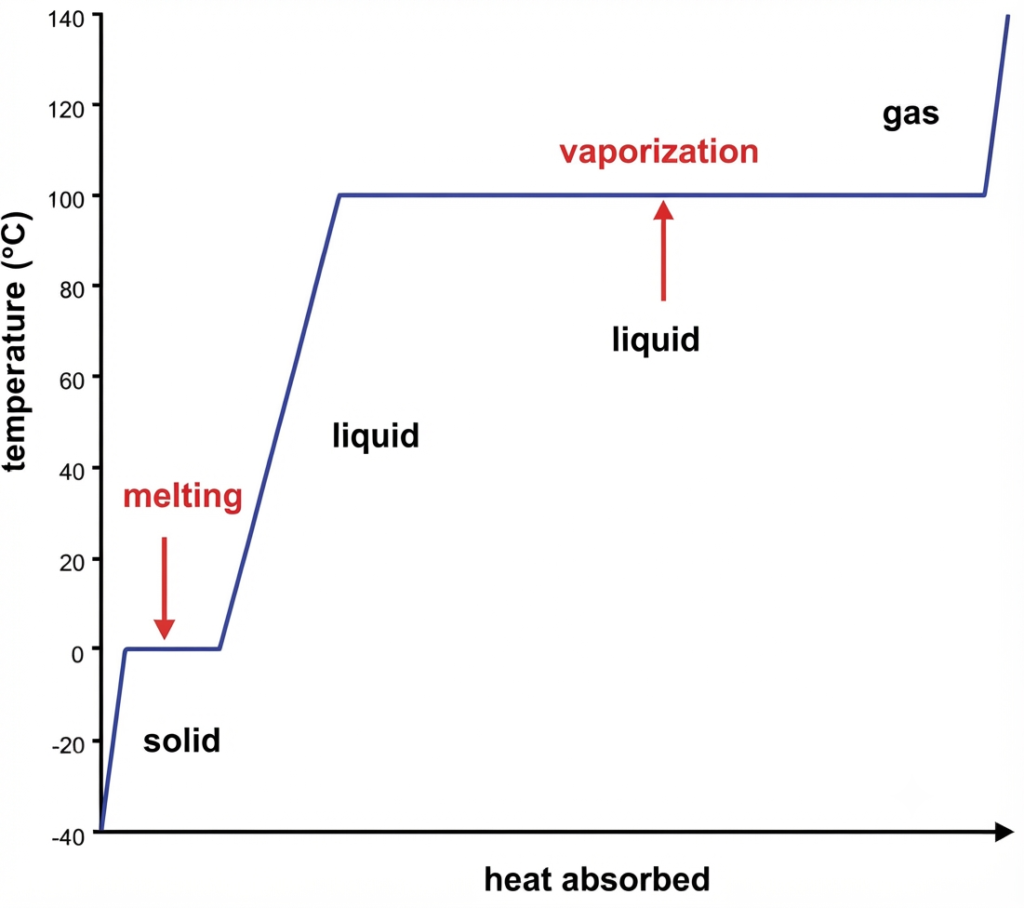
The heating curve shows how the temperature of water changes as heat is continuously supplied. During melting and boiling, the temperature remains constant because the supplied energy is used as latent heat instead of increasing the temperature.
Factors Affecting Phase Change
Several factors determine when and how a phase change occurs. The most important are temperature, pressure, and the properties of the substance.
1. Temperature
Temperature directly affects the energy of a substance’s particles. As heat is added, particles move faster and may overcome the forces holding them together, causing the substance to melt, boil, or even ionize. When heat is removed, particles lose energy, leading to condensation, freezing, or deposition.
2. Pressure
Pressure changes the temperature at which a substance changes its state. In general, increasing pressure raises the boiling point of a liquid, while reducing pressure lowers it. This is why water boils at a lower temperature in mountainous regions than at sea level.
Effect of Pressure on Boiling Point
Atmospheric pressure has a significant influence on the boiling point of liquids. At sea level, water boils at 100°C because the atmospheric pressure is approximately 101.3 kPa (1 atm). At higher altitudes, where atmospheric pressure is lower, water boils at a lower temperature. As a result, foods such as rice, vegetables, and pasta often require longer cooking times because the boiling water is cooler than it would be at sea level.
In contrast, increasing the pressure raises the boiling point. Pressure cookers use this principle to cook food faster by allowing water to remain in the liquid state at temperatures above 100°C.
3. Intermolecular Forces
The strength of the attractive forces between molecules also influences a phase change. Substances with strong intermolecular forces require more energy to melt or vaporize, resulting in higher melting and boiling points.
4. Nature of the Substance
Every material has its own characteristic melting point, boiling point, and latent heat. For example, water, mercury, and alcohol all undergo phase changes at different temperatures because of their unique physical properties.
Phase Change of Water
Water is one of the best examples for understanding a phase change because it can exist naturally as a solid, liquid, and gas. Under standard atmospheric pressure (1 atm), it melts at 0°C and boils at 100°C. During both processes, water absorbs latent heat while its temperature remains constant until the transition is complete.
| State | Phase Change | Temperature (at 1 atm) |
|---|---|---|
| Ice | Melting | 0°C |
| Liquid Water | Freezing | 0°C |
| Liquid Water | Boiling | 100°C |
| Steam | Condensation | 100°C |
The phase changes of water play a vital role in the Earth’s water cycle, climate regulation, cooling systems, and steam-based power plants. Its high latent heat allows it to store and transfer large amounts of thermal energy efficiently.
Water exhibits several unique properties that make it an excellent example for studying phase change. It has a high specific heat capacity and a high latent heat of vaporization, allowing it to absorb and release large amounts of thermal energy with relatively small temperature changes. These characteristics help regulate the Earth’s climate, moderate ocean temperatures, and enable efficient cooling in industrial equipment such as condensers and power plants.
Typical Phase Change Temperatures of Common Substances
Different substances undergo phase changes at different temperatures because of differences in their molecular structure and intermolecular forces. The table below compares the melting and boiling points of some commonly encountered materials under standard atmospheric pressure (1 atm).
| Substance | Melting Point | Boiling Point |
|---|---|---|
| Water | 0°C | 100°C |
| Ethanol | −114°C | 78°C |
| Mercury | −38.8°C | 356.7°C |
| Iron | 1538°C | 2862°C |
| Oxygen | −218.8°C | −183°C |
Note: The values in the table are approximate and apply at 1 atmosphere (101.3 kPa). Changes in pressure can shift the melting and boiling points of many substances.
Applications of Phase Change
The principles of phase change are used in numerous natural processes and engineering applications. By controlling the transfer of heat during a change of state, industries can improve energy efficiency, preserve materials, and manufacture a wide range of products.
Some common applications of phase change include:
- Refrigeration and air conditioning: Refrigerants absorb heat during evaporation and release it during condensation, providing effective cooling.
- Steam power plants: Water is converted into high-pressure steam to drive turbines and generate electricity before being condensed and reused.
- Weather and the water cycle: Evaporation, condensation, freezing, and melting are responsible for the formation of clouds, rain, snow, and hail.
- Food preservation: Freezing slows microbial growth and extends the shelf life of food products.
- Metal processing: Metals are melted for casting, welding, and manufacturing components with complex shapes.
- Thermal energy storage: Phase change materials (PCMs) store and release heat efficiently, making them useful in solar energy systems, green buildings, and temperature-controlled packaging.
- Medical and pharmaceutical industries: Controlled phase changes are used in cryopreservation, freeze-drying, and vaccine storage.
Importance of Phase Change in Nature
Phase changes continuously occur in the natural environment and are essential for sustaining life on Earth. The water cycle depends on evaporation, condensation, freezing, and melting to transport water between oceans, rivers, clouds, and the atmosphere. These processes regulate weather patterns, influence rainfall, and distribute heat around the planet.
Living organisms also rely on phase changes for temperature regulation. Humans cool their bodies through the evaporation of sweat, while many animals use similar mechanisms, such as panting, to remove excess body heat. Without these natural phase transitions, maintaining stable environmental and biological temperatures would be much more difficult.
Phase Change Materials (PCM)
Phase Change Materials (PCMs) are substances that store and release large amounts of thermal energy by changing their physical state. During melting or solidification, they absorb or release latent heat while maintaining a nearly constant temperature. Unlike ordinary materials that simply become hotter or colder, PCMs store energy through a change of state, making them highly effective for thermal energy storage and temperature regulation.
PCMs can be classified into three main categories:
- Organic PCMs: Paraffin waxes and fatty acids that offer good chemical stability and are widely used in buildings and electronic cooling.
- Inorganic PCMs: Salt hydrates and metallic compounds that provide higher thermal conductivity and greater energy storage capacity.
- Eutectic PCMs: Carefully formulated mixtures of two or more materials that melt and solidify at a specific temperature.
Applications of Phase Change Materials
PCMs are used in many industries to improve energy efficiency and temperature control, including:
- Energy-efficient buildings for maintaining indoor temperatures.
- Solar thermal systems to store excess heat for later use.
- Cold chain transportation for preserving food, medicines, and vaccines.
- Electronic devices to prevent overheating of batteries and electronic components.
- Textiles and protective clothing that help regulate body temperature.
- Heating, ventilation, and air conditioning (HVAC) systems to reduce energy consumption.
- Cryogenic engineering: Phase changes of liquefied gases such as liquid nitrogen and liquid oxygen are used in medical treatment, scientific research, and aerospace applications.
Because of their ability to store large amounts of heat in a small volume, phase change materials play a significant role in renewable energy systems, sustainable buildings, and modern thermal management technologies.
Supercritical Fluid
When a substance is heated and compressed beyond its critical temperature and critical pressure, it enters a supercritical fluid state. In this state, there is no clear distinction between the liquid and gas phases. A supercritical fluid combines the density of a liquid with the ability of a gas to flow easily.
Supercritical fluids possess both liquid-like and gas-like properties. They have the ability to dissolve substances like liquids while flowing easily through materials like gases. Because of these characteristics, supercritical carbon dioxide (CO₂) is widely used for extracting caffeine from coffee beans, producing essential oils, and cleaning precision electronic components without leaving harmful residues.
Because of these unique properties, supercritical fluids are widely used in:
- Carbon dioxide extraction of coffee and essential oils
- Chemical and pharmaceutical manufacturing
- Advanced power generation systems
- Precision cleaning and material processing
Plasma as a State of Matter
Plasma is often referred to as the fourth state of matter. It forms when a gas receives enough energy for its atoms to become ionized, producing a mixture of free electrons and positively charged ions.
Unlike ordinary gases, plasma conducts electricity and responds strongly to magnetic fields.
Common examples of plasma include:
- Lightning
- The Sun and other stars
- Neon and fluorescent lamps
- Plasma cutting and welding equipment
- Electric arc furnaces
As plasma loses energy, ions and electrons recombine, allowing the substance to return to the gaseous state.
Phase Change vs. Chemical Change
Although both processes involve changes in matter, a phase change only affects the physical state of a substance, whereas a chemical change produces one or more new substances with different properties.
| Feature | Phase Change | Chemical Change |
|---|---|---|
| Nature of Change | Physical | Chemical |
| New Substance Formed | No | Yes |
| Chemical Composition | Remains the same | Changes |
| Energy Involved | Absorbed or released | Absorbed or released |
| Usually Reversible | Often reversible | Often irreversible |
| Examples | Melting ice, boiling water | Rusting iron, burning wood |
Understanding this difference is important because many physical processes involve only a change in state, while chemical reactions permanently alter the composition of a material.
Conclusion
A phase change is a fundamental physical process in which a substance changes from one state of matter to another by absorbing or releasing thermal energy. Unlike a chemical reaction, the substance retains its original chemical composition throughout the transition. The concept of latent heat explains why energy is required for these changes even when the temperature remains constant. Phase changes are not only responsible for natural phenomena such as cloud formation, rainfall, and the water cycle but also support numerous industrial applications, including refrigeration, air conditioning, steam power generation, thermal energy storage, and advanced manufacturing.
Understanding the different types of state transitions, the factors that influence them, and their practical applications provides a solid foundation for studying thermodynamics, physics, chemistry, and engineering. Whether in nature or modern technology, phase changes play a vital role in everyday life and many scientific and industrial processes.
Read Next: