A gigatonne (Gt) is a metric unit of mass used to measure extremely large quantities. It is commonly seen in climate science, geology, environmental studies, mining, and Earth sciences, where values are too large to express conveniently in kilograms or tonnes.
For example, researchers often report global carbon dioxide emissions, glacier ice loss, and large mineral reserves in gigatonnes. Using this unit keeps scientific data concise and easier to understand.
In this article, you’ll learn what a gigatonne is, the gigatonne symbol, gigatonne in kg, gigatonne in tonne, conversion formulas, practical examples, and answers to frequently asked questions.
What Is a Gigatonne?
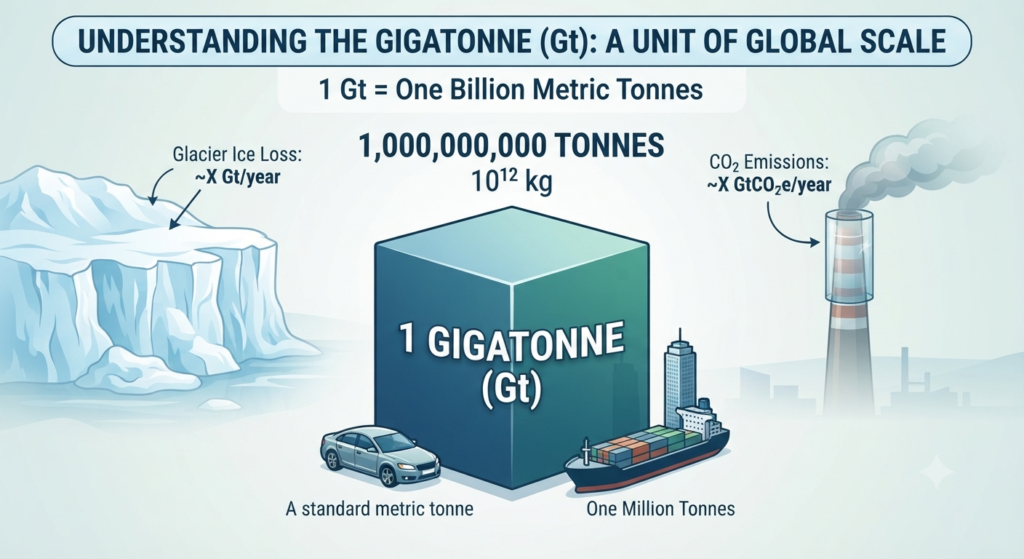
A gigatonne is equal to one billion (1,000,000,000) metric tonnes.
The word combines:
- Giga, an SI prefix representing 10⁹ (one billion)
- Tonne, the metric unit of mass equal to 1,000 kilograms
Together, they form a unit capable of representing enormous amounts of mass without using excessively large numbers.
Gigatonne Symbol and Terminology
The standard gigatonne symbol is:
Gt
Where:
- G = Giga (10⁹)
- t = Metric tonne
The uppercase G is part of the official SI notation and should always be written in capital form.
Gigaton vs. Gigatonne
While often used interchangeably, there is a slight distinction:
- Gigatonne (Gt): Always refers to one billion metric tonnes. It is the preferred term in modern scientific research and international standards.
- Gigaton: May sometimes refer to one billion U.S. short tons in older American publications.
Gigatonne Conversion Formulas and Tables
Gigatonne in kg
1 Gt = 1012 kg (1,000,000,000,000 kilograms).
- Formula: Kilograms = Gigatonnes ×1012
- Example: 3 Gt = 3,000,000,000,000 kg.
Gigatonne in Tonne
1 Gt = 109 tonnes (1,000,000,000 metric tonnes).
- Formula: Tonnes = Gigatonnes × 109
- Example: 6 Gt = 6,000,000,000 tonnes.
Gigatonne Conversion Table
| Gigatonnes (Gt) | Metric Tonnes (t) | Kilograms (kg) |
|---|---|---|
| 0.001 | 1,000,000 | 1,000,000,000 |
| 0.01 | 10,000,000 | 10,000,000,000 |
| 0.1 | 100,000,000 | 100,000,000,000 |
| 0.5 | 500,000,000 | 500,000,000,000 |
| 1 | 1,000,000,000 | 1,000,000,000,000 |
| 2 | 2,000,000,000 | 2,000,000,000,000 |
| 5 | 5,000,000,000 | 5,000,000,000,000 |
| 10 | 10,000,000,000 | 10,000,000,000,000 |
| 25 | 25,000,000,000 | 25,000,000,000,000 |
| 100 | 100,000,000,000 | 100,000,000,000,000 |
Gigatonnes to Tons Conversion
| Unit | Equivalent Value |
|---|---|
| 1 Gigatonne | 1,000,000,000 metric tonnes |
| 1 Gigatonne | ~1.102 billion U.S. short tons |
| 1 Gigatonne | ~984 million U.K. long tons |
Comparison: Gigatonne vs. Tonne vs. Gigagram
| Feature | Gigatonne (Gt) | Tonne (t) | Gigagram (Gg) |
|---|---|---|---|
| Mass in kg | 1012 kg | 1,000 kg | 106 kg |
| Equivalent Metric Tonnes | 1,000,000,000 t | 1 t | 1,000 t |
| Scale | Global | Industrial | Regional / Large |
| Typical Uses | Climate science, carbon emissions, glacier mass, Earth sciences | Manufacturing, transportation, construction, trade | Waste management, industrial production, large engineering projects |
| SI Symbol | Gt | t | Gg |
Why Scientists Use Gigatonnes
Scientists work with datasets that often involve billions of tonnes or trillions of kilograms. Writing these numbers repeatedly can make reports difficult to read and increase the chance of calculation errors.
Using gigatonnes offers several advantages:
- Simplifies very large measurements.
- Makes scientific reports easier to read.
- Reduces lengthy numerical values.
- Provides a consistent unit for international research.
- Improves comparisons between different studies and datasets.
Common Applications and Real-World Examples
A gigatonne is used whenever measurements become too large to express conveniently in tonnes or kilograms. It is an important unit in scientific research, environmental monitoring, and industries that deal with massive quantities of material, as it provides a concise way to report data without dealing with excessively large numbers.
- Climate Science and Carbon Emissions: Global carbon dioxide emissions are typically reported in gigatonnes each year. Scientists and policymakers use this unit to compare emission levels and carbon dioxide removal trends across countries and over time without writing billions of tonnes.
- Glaciology and Ice Sheet Loss: Researchers studying glaciers and polar ice sheets measure annual ice gain or loss in gigatonnes. These satellite observations help scientists understand sea-level rise and the effects of global warming.
- Geology and Mining: Large mineral deposits, coal reserves, and ore bodies are frequently estimated in gigatonnes. This allows geologists and mining companies to report reserves efficiently.
- Environmental Science and Forest Carbon Storage: Gigatonnes are used to estimate the massive amounts of carbon stored in forests and wetlands, helping to quantify carbon released through land-use changes.
- Oceanography and Ocean Carbon: Marine scientists use gigatonnes when studying ocean biomass, sediment accumulation, and the movement of carbon through marine ecosystems, as the oceans absorb a significant portion of atmospheric carbon dioxide.
Common Mistakes When Using Gigatonnes
Even though the concept is straightforward, a few common mistakes can lead to incorrect calculations or misunderstandings.
- Confusing a gigatonne with a gigagram.
- Mixing metric tonnes with U.S. short tons or U.K. long tons.
- Writing the symbol as gt instead of the correct Gt.
- Assuming the word gigaton always refers to a metric gigatonne without checking the context.
- Using tonnes when the quantity is more appropriately expressed in gigatonnes.
Being aware of these mistakes helps ensure accurate communication and calculations.
Conclusion
The gigatonne (Gt) is an essential metric unit for expressing extremely large masses that cannot be conveniently measured in tonnes or kilograms. It is widely used in climate science, geology, mining, and environmental research to simplify the reporting of large-scale measurements such as carbon emissions, glacier ice loss, and natural resource reserves.
By understanding the gigatonne symbol, conversion formulas, and its relationship with metric tonnes and kilograms, you can confidently interpret scientific data and technical reports. As environmental research and global sustainability efforts continue to grow, the gigatonne will remain one of the most important units for describing changes occurring on a planetary scale.
Whether you’re a student, engineer, researcher, or simply curious about large units of measurement, knowing how a gigatonne is defined and used will help you better understand the scale of our world’s biggest natural and industrial processes.
Read Next: